

Bank of Canada raises key interest rate to 2.50% amid persistent inflation
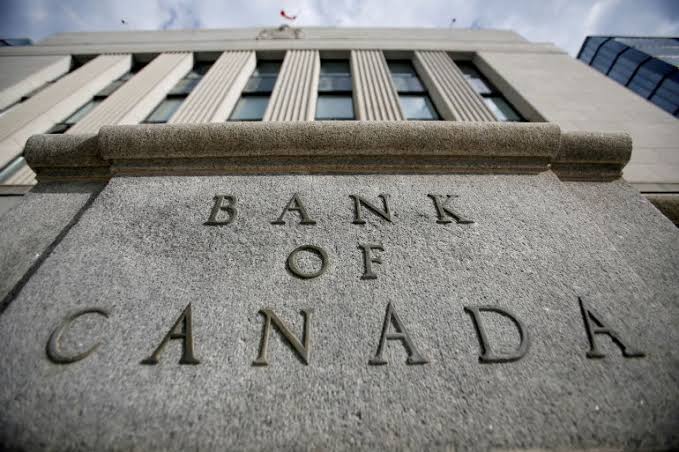
OTTAWA, Canada (Agency Report) — The Bank of Canada has raised its benchmark overnight interest rate by 25 basis points to 2.50 per cent, citing persistent inflationary pressures driven by elevated energy prices and uncertainty surrounding the global economic outlook.
In a statement issued on Wednesday, October 28, 2026, the central bank said the Bank Rate had been increased to 2.75 per cent, while the deposit rate rose to 2.45 per cent.
The bank said global economic activity had remained resilient since its July Monetary Policy Report, despite higher energy prices. It noted that the United States continued to record robust growth, supported by consumer spending and investment related to artificial intelligence, while economic activity in the euro area remained resilient and broad-based.

China’s economic growth also rebounded in the third quarter, driven by stronger exports and increased government spending.
However, persistently high oil prices and refinery margins had contributed to rising inflation in several countries.
The bank revised its global economic growth forecast slightly upwards to 3.1 per cent for 2026, while retaining its projections of 3.2 per cent for both 2027 and 2028.
It also reported tighter global financial conditions since July, with higher government bond yields in advanced economies and volatility in equity and credit markets amid uncertainty over the artificial intelligence sector.
The Canadian dollar, which had weakened against the US dollar, recovered to approximately 71 US cents, in line with the assumption in the bank’s July report.
Canadian economy records stronger growth
The Bank of Canada said economic growth had picked up in the middle of the year, with gross domestic product expanding by 3.3 per cent in the second quarter. Recent indicators suggested growth of about 2 per cent in the third quarter, exceeding the bank’s July projections.
Consumer spending remained solid despite slow population growth, while business investment rebounded, supported by activity in the oil and gas sector and spending on machinery and equipment.
Although sectors affected by US tariffs continued to face weakness, overall exports strengthened on the back of robust US demand, increased energy production and signs that Canadian businesses were adapting to changing trade conditions.
The unemployment rate had remained around 6.5 per cent for several months, while a broad range of indicators continued to point to some excess supply in the economy.
The bank expects new US tariffs to slow economic growth in Canada in the fourth quarter of 2026 before a recovery in 2027, supported by business investment, exports and fiscal measures. It also expects consumption growth to moderate and the housing market to remain relatively weak.
Canada’s economy is projected to grow by 1 per cent in 2026 and 2 per cent annually in 2027 and 2028, representing a somewhat stronger overall outlook than the July forecast.
However, the bank warned that considerable uncertainty remained, particularly regarding trade relations between Canada and the United States.
Inflation concerns drive rate increase
The central bank said consumer price index inflation had remained around 3 per cent since April and was expected to rise to approximately 3.5 per cent by the end of the year.
Excluding gasoline, inflation stood at 2.2 per cent in September, while measures of core inflation remained close to the bank’s 2 per cent target.
The bank warned that higher fuel prices were increasing production and transportation costs, while imported industrial and electronic input prices had also risen.
Although businesses had largely absorbed higher input costs so far, the bank’s surveys suggested that more companies would pass those costs on to consumers over the coming year.
Near-term inflation expectations among households and businesses had increased, although longer-term expectations remained well anchored.
The bank also highlighted the ongoing conflict in the Middle East, which it said had entered its eighth month without a clear path to resolution. It warned that prolonged high energy prices and the pass-through of rising costs could make inflation more persistent.
It projected inflation to average 3 per cent in 2027, one percentage point above its July forecast, before returning to 2 per cent by the middle of 2028.
Developments in the Middle East and how businesses respond to mounting cost pressures were identified as the main sources of uncertainty surrounding the inflation outlook.
Further rate increases remain possible
The Bank of Canada said its decision to raise the policy rate was intended to reduce the risk that persistently high energy prices would spread more broadly to the prices of other goods and services.
It cautioned that further rate increases might be necessary but said the Governing Council had agreed to proceed carefully given the uncertainties surrounding the economic outlook.
The bank reaffirmed its commitment to maintaining Canadians’ confidence in price stability as it seeks to contain inflation while supporting sustainable economic growth.

BOI targets ₦1.85tn annual financing for 24,000 MSMEs, three million jobs

Tinubu praises Dangote Group’s contribution to Nigeria’s economic growth

Peter Obi faults Tinubu’s one-month petrol discount, calls policy ‘reactive and confused’

JUST IN: Tinubu says World Bank report shows Nigeria’s economic reforms are working

JUST IN: Tinubu responds to commuters, highlights efforts to reduce transport costs

Fitch revises Nigeria’s credit outlook to positive, affirms ‘B’ rating

World Bank upgrades Africa growth outlook, says AI could boost jobs and productivity

Ardova takes Customer Service Week campaign to B2B customers
- Tinubu commissions NRS Headquarters, says new tax reforms will drive prosperity
- Tinubu assures investors of regulatory stability as Ogun, DP World sign $7bn port, SEZ MoUs
- Climate change anxiety is rising — and so is the willingness to act on it
- Imo police investigate viral video of officer assaulting man on Owerri–Orlu Road
- Baseball boosts TBS, NFL gives ESPN a kick and streamers love ‘Squid’
Community Discussion