

World Bank upgrades Africa growth outlook, says AI could boost jobs and productivity

Washington, DC. US (NPA) — The World Bank has raised its growth outlook for Sub-Saharan Africa, saying the region’s economy is gaining momentum despite heightened global uncertainty, regional conflicts and domestic pressures.
The World Bank projects economic growth in the region to rise from 4.1 per cent in 2025 to 4.3 per cent in 2026, with growth forecasts upgraded for nearly three-quarters of countries, including Nigeria, Angola, Ethiopia and Zambia.
However, the World Bank warned that the improving growth rate remains insufficient to substantially reduce extreme poverty or create enough jobs for Africa’s rapidly expanding labour force.

The assessment was contained in the World Bank’s October 2026 Africa Economic Update, titled “Building AI-Readiness,” which examines how artificial intelligence could help address some of the region’s persistent economic and development challenges.
According to the report, Africa’s most immediate opportunity lies not necessarily in developing advanced frontier AI systems, but in adopting and adapting affordable, practical AI applications to local needs.
The World Bank said such applications could improve productivity and service delivery in areas including education, agriculture, healthcare, finance, logistics and public administration.
It also noted that AI is more likely to complement workers than replace them in the near term, with much of its potential impact expected to come from helping workers perform their jobs more efficiently rather than from large-scale automation.
AI Opportunity Comes With Infrastructure Challenge
The World Bank said African countries will need to address major infrastructure and institutional gaps if they are to fully benefit from AI.
These include access to reliable electricity, affordable internet connectivity, digital skills, quality data and computing infrastructure, as well as effective institutions and governance.
The report warned that without these foundations, the benefits of AI adoption could remain concentrated in a small number of countries and firms.
AI adoption in Sub-Saharan Africa is currently concentrated in a relatively small number of economies, with Kenya, Nigeria and South Africa among the countries showing notable activity, according to the World Bank.
The bank said strengthening the foundations for an AI-ready economy could help countries translate technological adoption into higher productivity, greater innovation and more employment opportunities.
Growth Still Faces Major Constraints
Despite the improved growth outlook, the World Bank said countries across the region continue to face significant economic pressures.
High debt-service costs and limited fiscal space are constraining governments’ ability to invest in infrastructure, education, healthcare and social protection.
The World Bank also projects median inflation in Sub-Saharan Africa to rise from 3.7 per cent in 2025 to 5.5 per cent in 2026, driven partly by higher global fuel, food and fertiliser prices. Public debt has broadly stabilised at around 57 per cent of GDP, but rising debt-service costs continue to limit development spending.
The report identified geopolitical tensions, trade-policy uncertainty, tighter financial conditions, climate-related shocks and insecurity among the risks that could weaken economic activity across the region.
The World Bank said Africa’s challenge is therefore not simply to achieve higher economic growth, but to translate that growth into more jobs, higher productivity and better living standards.
It said investments in the foundations required for AI adoption could help accelerate that transition and create broader economic opportunities for the region’s rapidly growing population.

Nigeria, Ethiopia deepen cooperation on trade and investment

Uganda vaccinates more than 8.2 million children in Measles-Rubella Campaign

NCDC heightens vigilance after imported Ebola case confirmed in Kenya

Eswatini says three third-country nationals voluntarily return home
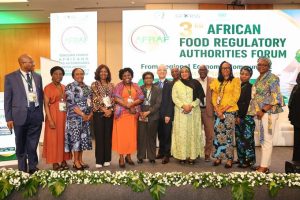
NAFDAC DG advocates stronger continental cooperation on food safety

AU Commission Chairperson congratulates Abiy Ahmed on re-election

Kenya opens new marketing channels for coffee farmers under Coffee Act 2026
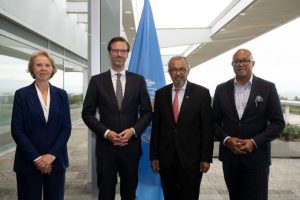
WHO, Netherlands strengthen partnership on Ebola, global health security and emergency response
- Tinubu commissions NRS Headquarters, says new tax reforms will drive prosperity
- Tinubu assures investors of regulatory stability as Ogun, DP World sign $7bn port, SEZ MoUs
- Climate change anxiety is rising — and so is the willingness to act on it
- Nigeria, Ethiopia deepen cooperation on trade and investment
- Baseball boosts TBS, NFL gives ESPN a kick and streamers love ‘Squid’
Community Discussion