

US sanctions Iranian missile and drone procurement networks
INTERNATIONAL (NPA) — The United States has imposed sweeping sanctions on 14 individuals, entities, and aircraft linked to Iran, Türkiye, and the United Arab Emirates (UAE) for their roles in procuring or transporting weapons and components for the Iranian regime. The measures, announced on 21 April 2026 by the Treasury Department’s Office of Foreign Assets Control (OFAC), form part of Economic Fury, Washington’s campaign to counter Iran’s missile and drone programs.
Treasury Secretary Scott Bessent said the sanctions underscore America’s determination to hold Tehran accountable for destabilising global energy markets and targeting civilians with missiles and drones. “Under President Trump’s leadership, as part of Economic Fury, Treasury will continue to follow the money and target the Iranian regime’s recklessness and those who enable it,” he declared.
The action builds on National Security Presidential Memorandum 2, which directs the US government to curtail Iran’s ballistic missile program, deny it nuclear weapons capability, and restrict the Islamic Revolutionary Guard Corps (IRGC) from accessing resources that sustain its activities. It also represents the fifth round of non‑proliferation designations since UN sanctions were reimposed in September 2025 following Iran’s “significant non‑performance” of nuclear commitments.

Targeting Shahed UAV Procurement
OFAC sanctioned three individuals tied to Iran’s Pishgam Electronic Safeh Company (PESC), already blacklisted in 2023 for supplying the IRGC Aerospace Force Self Sufficiency Jihad Organization. PESC procured thousands of servomotors used in Shahed‑136 one‑way attack drones, which have been deployed against US and allied targets.
Those designated include Tehran‑based currency exchanger Kamal Sabah Balkhkanlu, accused of facilitating payments for PESC’s procurement of carbon fibre and servomotors; Mohammad Vahidi, linked to shipments routed through Dubai; and Danial Khalili, who acted as PESC’s agent in receiving and delivering items.
Ballistic Missile Propellant Precursors
Sanctions also hit Türkiye‑based Emti Fiber Textile Import Export Trade Limited Company for supplying cotton linters to Iran’s Pardisan Rezvan Shargh International Private Joint Stock Company. Cotton linters are processed into nitrocellulose, a key ingredient in solid propellant rocket motors used in ballistic missiles.
OFAC further designated Iran’s Adak Pargas Pars Trading Company and its executives Hamidreza Roknifard and Mostafa Roknifard for facilitating procurement of sodium perchlorate, another missile propellant precursor. The company had previously assisted German national Marco Klinge, sanctioned in 2025 for supplying materials to Iran’s Defence Industries Organization.
Action Against Mahan Air
The sanctions extend to Iran’s Mahan Air, long accused of transporting weapons and UAV systems for the IRGC‑Qods Force. OFAC designated Mahan Air in 2011 under counter‑terrorism authorities and again in 2019 under non‑proliferation measures.
Entities linked to Mahan Air include Sepehr Kaveh Kish International Trading Company, its executives Gholam Abbas Ataei Aghdam and Jamshid Hosseinzadeh, and manager Mohammad Hossein Mahdian. OFAC also targeted Saman Air Services Company, a Mahan subsidiary that facilitated UAV shipments to Venezuela in coordination with state airline Conviasa.
Dubai‑based Chabok FZCO was sanctioned for procuring US‑origin aircraft components for Mahan Air. Additionally, two Boeing 777 aircraft, EP‑MTE and EP‑MTB, were identified as property in which Mahan Air has an interest.
Sanctions Implications
As a result of the designations, all property and interests in property of the sanctioned individuals and entities within US jurisdiction are blocked. US persons are prohibited from engaging in transactions with them, and entities owned 50 percent or more by designated persons are also blocked.
Violations may result in civil or criminal penalties, with OFAC enforcing sanctions on a strict liability basis. Foreign financial institutions risk secondary sanctions if they knowingly conduct significant transactions on behalf of designated persons.
OFAC emphasised that the ultimate goal of sanctions is behavioural change, not punishment. It noted that individuals and entities may petition for removal from the Specially Designated Nationals (SDN) list if they demonstrate compliance with US law.
Broader Context
Iran has increasingly relied on Shahed‑series drones to strike energy infrastructure and civilian targets across the Middle East. Washington argues that Tehran’s procurement networks in Türkiye, the UAE, and beyond are critical to sustaining these operations. By targeting facilitators, suppliers, and transporters, the US aims to deplete Iran’s missile inventories and prevent reconstitution of its production capacity.
The latest measures reinforce Washington’s dual approach: constraining Iran’s weapons programs while signalling to international partners that cooperation with Tehran’s procurement networks carries significant risks.
Secretary Bessent concluded: “The Iranian regime must be held accountable for its extortion of global energy markets and indiscriminate targeting of civilians with missiles and drones. Treasury will continue to act decisively against those who enable Iran’s destabilising activities.”

Netanyahu condemns Houthi’s missile strike on Riyadh Airport as death toll reaches 12

Media Freedom Coalition demands justice 20 years after Anna Politkovskaya’s assassination
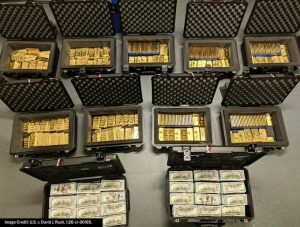
Former US federal employee pleads guilty to $194 million government fraud scheme

Rubio says US will never forget October 7 Hamas barbaric attack on Israel
Russia accuses Ukraine of attacks on Zaporizhzhia nuclear power plant

German Chancellor Friedrich Merz visits Kyiv as Zelenskyy reports Russian drone strikes across Ukraine

27% of EU young people lived in overcrowded homes in 2025 — Eurostat

WHO, Netherlands strengthen partnership on Ebola, global health security and emergency response
- Tinubu commissions NRS Headquarters, says new tax reforms will drive prosperity
- Tinubu assures investors of regulatory stability as Ogun, DP World sign $7bn port, SEZ MoUs
- Climate change anxiety is rising — and so is the willingness to act on it
- Ohaukwu LG Chairman Ituma breaks ground for modern diagnostic centre, blood bank
- Baseball boosts TBS, NFL gives ESPN a kick and streamers love ‘Squid’
Community Discussion