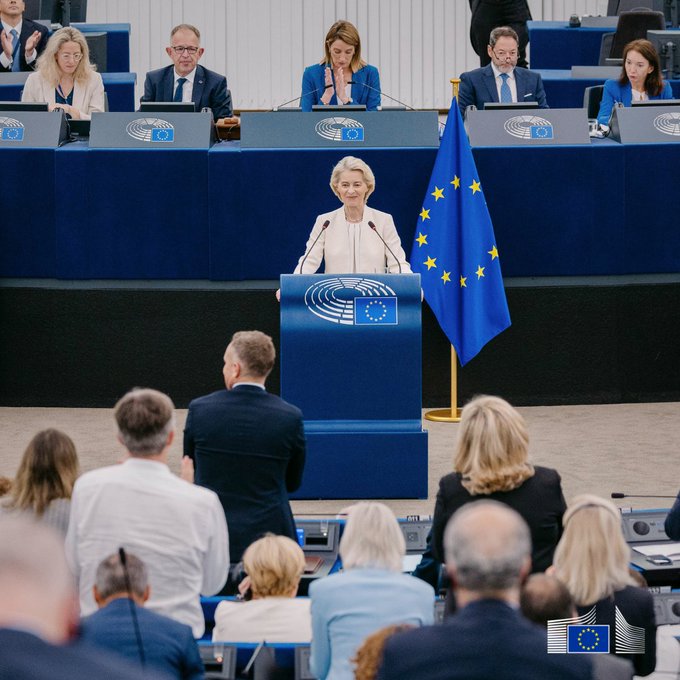
STRASBOURG, France (NPA) — European Commission President Ursula von der Leyen has outlined an ambitious agenda for a stronger and more independent European Union, focusing on economic competitiveness, energy security, defence, artificial intelligence, climate resilience, migration, democracy and support for Ukraine.
Addressing the European Parliament in Strasbourg on Wednesday in her 2026 State of the Union speech, von der Leyen said Europe was navigating a period of exceptional challenges and opportunities, with geopolitical tensions, wars, economic pressures and rapid technological change reshaping the global environment.
The European Commission describes the annual State of the Union address as an opportunity for its president to take stock of the previous year and set out priorities and major initiatives for the year ahead.
Von der Leyen said Europe had chosen to pursue greater strategic independence, arguing that the bloc needed greater capacity to determine its economic, energy, technological and security priorities.
She said the EU had reduced its dependence on Russian fossil fuels, expanded its trading relationships and increased defence spending, while continuing to support Ukraine and respond to what she described as hybrid threats, including drones, cyberattacks and disinformation.
“Europe has chosen to forge its own path,” she said, presenting greater European independence as a central theme of her administration’s agenda.
Economy and single market
On the economy, von der Leyen said Europe’s immediate priority was to accelerate economic growth while dealing with higher energy prices and borrowing costs.
She pointed to the size of the European market, its industrial and services base, savings and currency as major economic strengths, but said fragmentation across capital markets, networks and purchasing power continued to limit the bloc’s potential.
She announced plans to accelerate implementation of the “One Europe, One Market Roadmap”, with the aim of completing an overhaul of the EU Single Market by the end of next year.
She also called for faster approval of strategic projects and a reduction in administrative burdens facing businesses and small and medium-sized enterprises.
According to von der Leyen, the Commission’s 12 omnibus proposals are expected to reduce administrative costs by about €17 billion annually.
She urged EU member states to contribute to simplification efforts and called for a pact against what she described as “gold-plating” — the addition of requirements beyond those necessary to implement EU rules.
Energy and critical raw materials
Energy independence featured prominently in the address.
Von der Leyen said Europe needed to increase investment in homegrown clean energy, including renewables and nuclear power, while reducing its exposure to imported fossil fuels.
She said imported fossil fuels had cost Europe an additional €90 billion since the start of the conflict surrounding the Strait of Hormuz, without adding energy supply.
She proposed increasing the share of electricity in Europe’s energy mix and said the bloc’s target was to double that share by 2040.
The Commission president also called for faster investment in electricity grids, storage capacity and grid connections, noting that a large amount of renewable energy capacity was still awaiting connection.
On trade and strategic dependencies, she said Europe’s trade deficit with China had reached €1 billion a day and warned that the imbalance was affecting European industries and communities.
She said the EU would continue discussions with Beijing while using available instruments to seek a rebalancing of the relationship.
Von der Leyen also said Europe remained heavily dependent on China for critical raw materials, including rare earths, and announced plans for a European corporation focused on securing and stockpiling critical materials needed for electric vehicles, semiconductors, batteries, clean technologies and defence.
Climate change and preparedness
Climate change was another major component of the speech.
Von der Leyen pointed to the severe wildfires, heatwaves, crop losses and other extreme weather events experienced across Europe during the summer.
She said Europe was warming at twice the global rate and argued that climate mitigation and adaptation needed to be pursued together.
The Commission will present a new framework for climate resilience, including an assessment of 100 of Europe’s most vulnerable territories, she said.
She also announced plans for a Climate Insurance Alliance to address the gap between climate-related losses and insurance coverage.
According to her, only about 25 per cent of catastrophe losses in Europe are currently covered by private insurance.
A European Heatwave Plan is also expected, focusing on early warning systems, health preparedness, urban adaptation and protection of vulnerable populations.
The Commission also plans a European Water initiative to address water scarcity, ageing infrastructure and losses from leaking water networks.
On wildfires, von der Leyen proposed further work towards a possible European Firefighting Fleet, following cross-border cooperation during recent emergencies.
Artificial intelligence
Artificial intelligence was described as another major area requiring both investment and safeguards.
Von der Leyen said AI was becoming increasingly important to Europe’s economy and security but warned of potential risks associated with increasingly capable frontier models.
She said the EU’s AI Act provided an important regulatory framework and announced plans for closer cooperation with countries including Canada and the United Kingdom on model evaluation, verification, early warning systems and AI security.
She also called for increased European computing capacity and investment in European AI companies and start-ups.
The Commission plans to focus industrial AI initiatives on five sectors: health, transport, agri-food, advanced manufacturing, and defence and space.
Von der Leyen said AI should be used to empower professionals rather than replace them, citing healthcare as an example.
She also announced a Quality Jobs Act, saying technological change should be accompanied by efforts to improve workers’ skills and employment opportunities.
Social rights and housing
The speech also addressed social policy, housing and demographic change.
Von der Leyen said the Commission would launch a European Care Deal and continue investing in regions to give people greater opportunities to remain in their communities.
She also referred to the proposed Housing Act, which seeks to address issues including short-term rentals and housing speculation.
She reaffirmed the Commission’s position on women’s rights and said it would continue defending equal treatment, equal opportunities and equal pay.
Defence and Ukraine
Security and defence occupied a substantial part of the address.
Von der Leyen said Europe’s increased defence spending had generated higher investment in military capabilities and joint projects, but argued that more cooperation was needed.
She proposed a European Instrument for Strategic Enablers to support capabilities such as air and missile defence, strategic transport, air-to-air refuelling, space and cyber systems.
She also proposed what she described as an Emergency Security Protocol that would allow EU member states to coordinate responses to certain security incidents that fall below the threshold of armed aggression.
On Ukraine, von der Leyen said the EU would maintain strong support as the country prepares for another difficult winter.
She said Europe would provide humanitarian assistance, reinforce Ukraine’s power and heating supplies and strengthen its air defences.
She also referred to the approval of the purchase of US Patriot interceptor missiles and proposed further European-Ukrainian cooperation on missile defence through the Freya project.
She called for stricter enforcement of sanctions against Russia and efforts to close loopholes that allow sanctions to be circumvented.
Gaza and the Middle East
On the Middle East, von der Leyen said the humanitarian situation in Gaza and violence in the West Bank remained a major concern for Europeans.
She criticised Israel’s advancement of the E1 settlement project and acknowledged divisions among EU member states over how the bloc should respond.
She said Europe had provided significant humanitarian assistance to Palestinians and referred to nearly €1 billion pledged through the Palestine Donor Group and Team Gaza Initiative for rebuilding Gaza and supporting a modern Palestinian Authority.
Von der Leyen reaffirmed support for Israel’s right to self-defence while also saying Palestinians had an equal right to live in safety and dignity.
She said Europe should continue working towards a two-state solution.
Migration and democracy
Migration and border management also featured prominently.
Von der Leyen said the EU’s external borders were a shared European responsibility and called for full implementation of the Pact on Migration and Asylum.
She cited a 55 per cent reduction in irregular arrivals over the previous two years and a further 35 per cent decline in the current year, according to the figures presented in her address.
She proposed a European Emergency Response Framework for situations involving mass movements of migrants and said the EU would strengthen Frontex, improve early-warning systems and address the root causes of irregular migration.
She also announced a Mediterranean Youth Skills and Jobs initiative aimed at expanding employment, training and skills opportunities for young people in partner countries.
On democracy, von der Leyen warned about foreign interference, disinformation, deepfake videos and other forms of what she called cognitive warfare.
She said the EU would strengthen its Centre for Democratic Resilience and continue efforts to protect democratic institutions and independent information.
The Commission president also announced the proposed EU KIDS ACT, which would introduce age-based restrictions and protections for children using social media.
Under the proposal outlined in the speech, children under 13 would not have access to social media, while those aged 13 to 15 would use supervised accounts with limited features and time restrictions.
Von der Leyen also announced plans for a wider Digital Fairness Act to address concerns about addictive digital design.
Global partnerships
The Commission president also outlined plans to deepen Europe’s international partnerships.
She highlighted recent and planned trade agreements and announced a new connectivity project linking the South Caucasus and Central Asia with European markets through the Middle Corridor.
The initiative, to be supported through the EU’s Global Gateway programme, aims to attract up to €12 billion in public and private investment.
Von der Leyen also proposed moving the EU-Canada relationship beyond the existing CETA framework towards what she described as an “Alliance for the Future”, covering areas including technology, defence, energy, critical minerals, batteries, artificial intelligence, quantum technology and cybersecurity.
She invited Canada to become the first associate member of the European Union.
Concluding her address, von der Leyen called for renewed European cooperation and said the bloc’s future should be shaped by its member states and citizens.
She announced plans for a new Congress of Europe ahead of the 70th anniversary of the Treaty of Rome in 2027, saying it would bring together thinkers from across the continent to develop a vision for the next generation.
The European Commission has framed the 2026 State of the Union around strengthening Europe’s ability to act in a changing world, with competitiveness, strategic independence, defence, Ukraine, international partnerships, democracy and citizen protection among its stated priorities.