

Russia, China declare support for multipolar world order, reject global hegemony
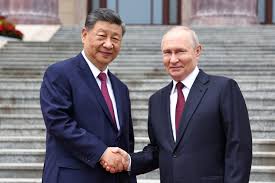
INTERNATIONAL (NPA) — The governments of Russia and China have jointly declared support for the establishment of a multipolar world order and a new framework for international relations, warning against what they described as growing hegemonism, bloc confrontation and unilateral control of global affairs.
The joint statement comes as Vladimir Putin paid a state visit to China shortly after Donald Trump departed the country.
In a Joint Declaration released on May 20, both countries said the current international system is undergoing a “profound transformation” as global power shifts away from dominance by a small group of states toward what they called a more balanced and polycentric world order.
The declaration, titled “Joint Declaration of the Russian Federation and the People’s Republic of China on the Establishment of a Multipolar World and a New Type of International Relations,” reaffirmed longstanding cooperation between the two nations and referenced a series of previous bilateral agreements dating back to 1997.
According to the statement, Russia and China described themselves as major centres of influence in the emerging multipolar system and pledged to continue playing what they called a constructive role in maintaining global balance and reforming international relations.
The two countries argued that the global political landscape has changed significantly since the end of World War II and the Cold War, pointing to the rise of sovereign states across Asia, Africa, Latin America, the Caribbean and the Middle East.
They noted that the growing influence of developing nations and regional organisations demonstrates that attempts by certain countries to unilaterally dominate global affairs or impose their interests on other states have failed.
The declaration also criticised what it described as neocolonial tendencies in modern international politics, including the use of unilateral force, hegemonic policies, military alliances and bloc confrontation.
Russia and China warned that repeated violations of international law and weakening global governance institutions are creating new threats to peace and development, adding that the world risks returning to what they described as the “law of the jungle.”
As part of the declaration, both countries called on the international community to adopt principles aimed at building what they described as a more equal and orderly international system.
The first principle emphasised openness and mutually beneficial cooperation among sovereign states, while rejecting coercive policies and attempts to divide the world into rival blocs.
According to the statement, every country has the right to choose its own political and economic development model without outside interference.
The declaration also stressed the principle of “indivisible and equal security,” arguing that no country should strengthen its security at the expense of another.
Russia and China opposed the expansion of military alliances, proxy conflicts and hybrid warfare, while calling for disputes to be resolved peacefully through dialogue and respect for the security concerns of all nations.
The two governments further advocated reforms to global governance institutions, including the United Nations, insisting that developing countries should have greater representation and influence in international decision-making.
According to the declaration, the UN Charter remains the fundamental basis of international relations and should not be replaced by rules imposed by a limited group of countries.
The statement also emphasised cultural and civilizational diversity, arguing that no civilisation or value system should be regarded as superior to another.
Russia and China condemned the politicisation of human rights issues and opposed the use of human rights as justification for interference in the internal affairs of sovereign states.
The declaration additionally called for stronger dialogue among civilisations, religions and cultures, saying such engagement is necessary to promote mutual understanding and global stability.
Both countries concluded by pledging to continue developing a shared vision for what they described as a more equitable multipolar world and a new type of international relations based on equality, sovereignty and mutual respect.

Netanyahu condemns Houthi’s missile strike on Riyadh Airport as death toll reaches 12

Media Freedom Coalition demands justice 20 years after Anna Politkovskaya’s assassination

Former US federal employee pleads guilty to $194 million government fraud scheme

Rubio says US will never forget October 7 Hamas barbaric attack on Israel
Russia accuses Ukraine of attacks on Zaporizhzhia nuclear power plant

German Chancellor Friedrich Merz visits Kyiv as Zelenskyy reports Russian drone strikes across Ukraine

27% of EU young people lived in overcrowded homes in 2025 — Eurostat
WHO, Netherlands strengthen partnership on Ebola, global health security and emergency response
- Tinubu commissions NRS Headquarters, says new tax reforms will drive prosperity
- Tinubu assures investors of regulatory stability as Ogun, DP World sign $7bn port, SEZ MoUs
- Climate change anxiety is rising — and so is the willingness to act on it
- Ohaukwu LG Chairman Ituma breaks ground for modern diagnostic centre, blood bank
- Baseball boosts TBS, NFL gives ESPN a kick and streamers love ‘Squid’
Community Discussion