

Dangote’s $16bn Kenya refinery faces second legal challenge over transparency
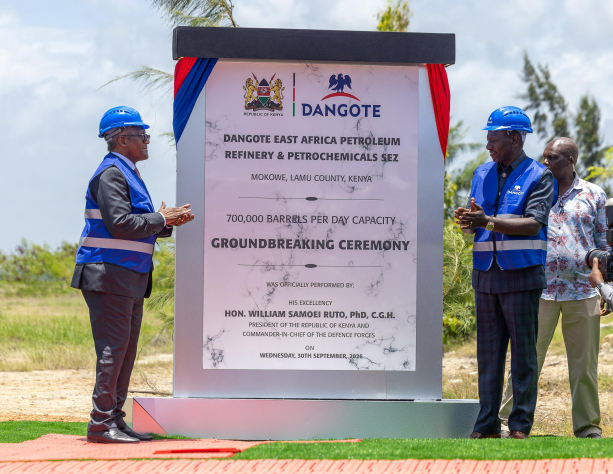
NAIROBI, Kenya (NPA) — Dangote Industries’ planned $16 billion oil refinery in Kenya is facing a second legal challenge within a week, with a consumer-rights organisation seeking disclosure of key details surrounding the proposed 700,000-barrel-per-day facility in Lamu County.
The Consumers Federation of Kenya (COFEK) has filed a petition before the Public Private Partnerships (PPP) Petition Committee, questioning the transparency of the project and seeking information on the Kenyan government’s proposed stake and other public commitments.
COFEK Secretary-General Stephen Mutoro announced the petition in a post on X.

The organisation is seeking disclosure of details including the proposed vehicle through which the Kenyan government would acquire its stake, the class of shares involved, payment terms, the approvals granted for the project and evidence of public participation.
COFEK is also asking the PPP Petition Committee to set aside and reconsider any approvals it finds to have been made without compliance with applicable requirements.
The petition comes days after a separate legal challenge by 133 residents of Chandavai in Lamu County, who claim that land earmarked for the refinery is ancestral property.
First legal challenge: Lamu residents’ land claim
The first case centres on Land Reference No. 13061 in the Hindi/Manda Magogoni area of Lamu County.
The 133 residents, represented in proceedings brought by Salim Tima Swale, have challenged the planned development, claiming an interest in the land based on ancestral occupation and use.
The Malindi Environment and Land Court has ordered the parties to maintain the status quo on the disputed parcel pending an inter partes hearing scheduled for Oct. 14, 2026. The court declined to certify the application as urgent but directed the respondents to file their responses.
The land dispute is significant because Kenya’s Constitution recognises community land, including ancestral land and land traditionally occupied by certain communities. Article 63 provides that community land vests in the relevant community and cannot be disposed of or otherwise used except in accordance with legislation governing the rights of community members.
The Community Land Act also recognises customary land rights and provides protection against compulsory acquisition except in accordance with the law, for a public purpose and upon prompt payment of just compensation.
If the land is being acquired compulsorily, Kenya’s Land Act requires the prescribed acquisition process to be followed, including the involvement of the National Land Commission and the payment of just compensation. Kenyan courts have emphasised that compensation must be prompt and paid in full where compulsory acquisition lawfully occurs.
The current court order, however, does not establish that the residents are the lawful owners of the disputed land or that the refinery’s land acquisition is unlawful. Those issues remain before the court.
COFEK challenges project transparency
The second challenge is focused less on land ownership and more on the proposed public-private structure and disclosure of government commitments.
COFEK’s petition comes amid reports that Kenya is considering taking a stake in the refinery. COFEK is seeking information on how that stake would be acquired, the entity or vehicle that would hold it, the class of shares, payment arrangements and the approvals supporting the proposed investment.
The PPP Petition Committee is a statutory body established under Kenya’s Public Private Partnerships Act, 2021, to adjudicate petitions and complaints arising during the tendering and entry into PPP project agreements.
Kenya’s PPP framework also contains disclosure requirements for privately initiated proposals, while the Access to Information Regulations require public entities to disclose specified information relating to PPPs.
The transparency challenge therefore puts the project’s proposed public investment, approvals and contractual arrangements under scrutiny.
A Dangote Group spokesperson declined to comment, while a Kenyan government spokesperson did not immediately respond to a request for comment, according to the report.
Environmental and public-participation requirements
Beyond the two current legal challenges, the company and its Kenyan partners will need to ensure that all applicable environmental and community-engagement requirements are fully satisfied.
Kenya’s National Environment Management Authority (NEMA) states that projects requiring environmental impact assessment must complete the EIA process and obtain the relevant licence before commencement. The process requires affected persons and communities to be consulted, including through public meetings and written or oral submissions.
For a project of the refinery’s scale, the company should therefore maintain a comprehensive record of environmental assessments, consultations, stakeholder submissions, responses to concerns and all relevant licences and approvals.
The Constitution also requires public participation in environmental management and provides for access to information held by the state, while the Access to Information Regulations impose disclosure obligations concerning PPPs and certain information held by private bodies relating to public resources, environmental protection and public health and safety.
How Dangote can address the legal challenges
The most practical route for Dangote would be to resolve the process and documentation issues transparently rather than treating the litigation solely as an obstacle to construction.
First, the company should work with the Kenyan government and National Land Commission to publish or make available the legal basis for the acquisition and use of the refinery site, including the land tenure status, survey information, acquisition notices, compensation framework and records showing how affected interests were identified.
Second, where residents have established compensable interests, the project should ensure that compensation and any applicable resettlement measures comply fully with the Constitution, the Land Act and the Community Land Act. This should be independently verified rather than left solely to negotiations between the company and individual claimants.
Third, Dangote and the government should provide a clear public information package covering the proposed government equity stake, ownership structure, financing arrangements, project agreements, government support measures and applicable approvals, subject only to lawful confidentiality restrictions.
Fourth, the company should ensure that its environmental and social documentation is complete and that affected communities have meaningful opportunities to participate in the process. NEMA specifically requires affected communities to be consulted during the EIA process.
Fifth, Dangote should establish a formal community grievance mechanism involving representatives of affected communities, county authorities, the National Land Commission and other relevant agencies. Such a mechanism could allow legitimate complaints over land, compensation, employment, environmental effects and access to community resources to be addressed before they escalate into additional litigation.
Finally, the company should respect the court’s existing status-quo order and allow the Oct. 14 proceedings to determine the immediate land dispute while preparing its documentary response.
Dangote remains committed to project
Dangote is seeking to replicate the scale of its 700,000-barrel-per-day refinery in Nigeria with the planned Lamu facility, which is expected to be completed around 2030.
The project was formally launched in Lamu on Sept. 30, with Kenyan President William Ruto and other African leaders attending the groundbreaking ceremony. The refinery is intended to supply petroleum products to Kenya and other East African markets.
Dangote has said the legal dispute would not stop the project’s groundbreaking, although the court order could affect activities on the disputed site.
The latest COFEK petition adds a second layer of scrutiny, meaning the project’s progress will now depend not only on its financing and construction timetable, but also on its ability to satisfy Kenya’s requirements on land rights, environmental protection, public participation, transparency and PPP governance.

Ethiopian Airlines orders 10 Boeing freighters to expand cargo fleet
South Africa police arrest five suspects, recover drugs, copper and hijacked vehicles

Kenya hosts regional mission on port security, safety of navigation

Ghana Armed Forces launch week-long rabies prevention campaign in STMA

BREAKING: Woman shot dead during alleged robbery in Thembisa

South Africa shootings leave 27 dead, 26 injured as police launch manhunts

Shettima urges new ECOWAS leadership to prioritise unity, integration

UNGA81: AfDB, partners launch free AI training for African public officials
- Tinubu commissions NRS Headquarters, says new tax reforms will drive prosperity
- Tinubu assures investors of regulatory stability as Ogun, DP World sign $7bn port, SEZ MoUs
- Climate change anxiety is rising — and so is the willingness to act on it
- Dangote’s $16bn Kenya refinery faces second legal challenge over transparency
- Baseball boosts TBS, NFL gives ESPN a kick and streamers love ‘Squid’
Community Discussion