

Nigeria's capital importation rises 83.8% to $10.37 billion in Q1 2026

ABUJA, Nigeria (NPA) — Nigeria recorded a total capital importation of $10.37 billion in the first quarter of 2026, representing an 83.83 per cent increase from the $5.64 billion reported in the corresponding period of 2025, according to the latest Capital Importation Report released by the National Bureau of Statistics (NBS).
The report also showed a 60.97 per cent quarter-on-quarter increase compared to the $6.44 billion recorded in the fourth quarter of 2025, signalling renewed investor interest in Africa’s largest economy.
According to the NBS, portfolio investment remained the dominant source of capital inflows, accounting for $9.86 billion or 95.09 per cent of total capital imported during the period.

Other investments contributed $374.48 million, representing 3.61 per cent of total inflows, while Foreign Direct Investment (FDI) recorded the lowest share at $135.08 million, accounting for just 1.30 per cent.
A breakdown of the report revealed that the banking sector continued to serve as the primary gateway for foreign capital entering the country, accounting for the largest share of inflows.
Standard Chartered Bank Nigeria Limited emerged as the leading recipient institution, attracting $4.41 billion, representing 42.56 per cent of total capital importation.
It was followed by Stanbic IBTC Bank Plc, which recorded inflows of $2.78 billion or 26.79 per cent, while Rand Merchant Bank attracted $930.82 million, representing 8.97 per cent.
Citibank Nigeria Limited and Access Bank Plc completed the top five with capital inflows of $782.84 million and $710.03 million, respectively.
Sectoral analysis showed that banking and financing activities dominated investment inflows, jointly accounting for more than 96 per cent of total capital imported during the quarter.
The financing sector attracted $2.43 billion, representing 23.42 per cent of total inflows, while production and manufacturing received $152.27 million or 1.47 per cent.
Investment in shares accounted for $75.34 million, representing 0.73 per cent of total inflows.
Other sectors recorded comparatively smaller investments, including trading with $65.79 million, agriculture with $37.28 million, and information technology services with $11.33 million.
The telecommunications, transport, and construction sectors collectively accounted for less than one per cent of total capital importation during the period.
The NBS noted that the continued dominance of the banking sector reflects the critical role of financial institutions in facilitating foreign investment into Nigeria.
The strong performance recorded in the first quarter of 2026 points to improving investor confidence and a gradual recovery in capital inflows, supported largely by increased portfolio investments and sustained interest in Nigeria’s financial sector.

Peter Obi faults Tinubu’s one-month petrol discount, calls policy ‘reactive and confused’

JUST IN: Tinubu says World Bank report shows Nigeria’s economic reforms are working

JUST IN: Tinubu responds to commuters, highlights efforts to reduce transport costs

Fitch revises Nigeria’s credit outlook to positive, affirms ‘B’ rating

World Bank upgrades Africa growth outlook, says AI could boost jobs and productivity
NDB approves $395m for Hyderabad elevated transport corridor
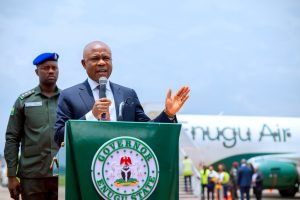
Mbah reaffirms commitment to tourism, transport as Enugu Air launches Douala route

Tinubu hails US-Nigeria agreement to unlock $700bn mineral wealth
- Tinubu commissions NRS Headquarters, says new tax reforms will drive prosperity
- Tinubu assures investors of regulatory stability as Ogun, DP World sign $7bn port, SEZ MoUs
- Climate change anxiety is rising — and so is the willingness to act on it
- Ohaukwu LG Chairman Ituma breaks ground for modern diagnostic centre, blood bank
- Baseball boosts TBS, NFL gives ESPN a kick and streamers love ‘Squid’
Community Discussion