Category: Technology

  • Iran’s internet blackout hits record 37 days, deepens uncertainty

    Iran’s internet blackout hits record 37 days, deepens uncertainty

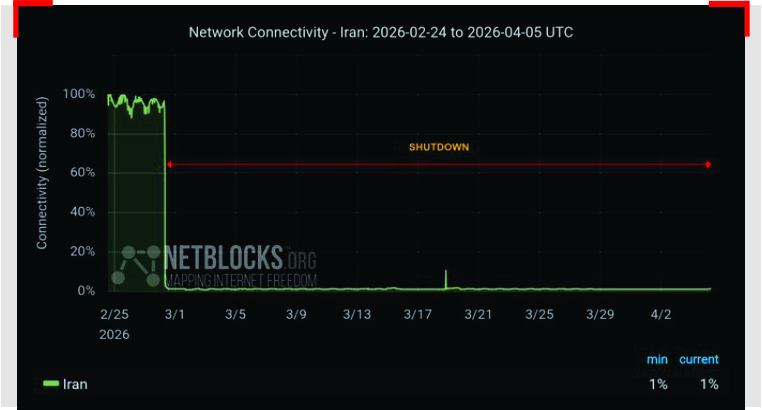
    MIDDLE EAST, April 5, 2026 (NPA) — Iran’s internet blackout has become the longest nation-scale shutdown ever recorded, now in its 37th consecutive day after 864 hours, according to NetBlocks. The disruption has triggered severe social and economic consequences, cutting off communication among citizens, families, and communities, while blocking access to vital information and limiting the ability to organize or express dissent.

    Education has been hampered as students and teachers lose access to online platforms, and healthcare services reliant on telemedicine have been restricted. The blackout has also isolated the population from the global community, fuelling uncertainty and reducing transparency.

    Economically, the shutdown has damaged businesses dependent on online transactions, banking, and international trade. Small enterprises and freelancers who rely on digital platforms for income have been hit hardest, losing clients and revenue during the prolonged outage.

    Foreign investors view the blackout as a sign of instability, discouraging investment and weakening growth. Overall, the blackout not only suppresses freedom of expression but also undermines economic resilience and development.

    As of filing this report, Iranian authorities have yet to communicate when or how the internet blackout will end.

  • From vanity to value: The real secret behind winning Nigeria’s mobile audience

    From vanity to value: The real secret behind winning Nigeria’s mobile audience

    OPINION, April 4, 2026 (NPA) —Nigeria is undeniably a mobile-first market, but that does not mean every company should rush to build its own app. Too often, strategies confuse access with appetite, or downloads with loyalty.

    Users will only keep an app if it delivers consistent, practical value. In Nigeria, where data costs are high, storage space is limited, and attention is fiercely contested, an app that fails to solve a recurring problem quickly becomes disposable.

    This is the real challenge for corporates considering streaming platforms. The issue is not whether an app looks modern or impressive, but whether it offers enough ongoing value to justify a permanent place on someone’s phone. For most companies, the honest answer is still “not yet.” Without strong, regular, exclusive content, branded streaming apps risk becoming expensive digital monuments—ambitious in appearance but rarely part of everyday life.

    Social media, by contrast, is already woven into the daily rhythm of Nigerian society. It is where people discover, discuss, learn, watch, argue, laugh, compare, and share. For many brands, social handles are not a weakness but the most realistic starting point.

    Still, social platforms are borrowed ground. They provide reach, visibility, and conversation, but they do not give brands full control over their audience, data, or long-term distribution. The smarter approach is layered: use social media for discovery and relevance; YouTube and video platforms for depth and repeat viewing; WhatsApp for direct connection, community, and service; then link all of these back to an owned destination—whether a website, content hub, membership platform, or lighter digital environment under the brand’s control. In this model, content works harder and audience relationships last longer.

    Ultimately, content matters more than the platform. Corporates should focus less on polished self-promotion and more on useful, human, repeatable value. Audiences respond to content that helps them do something, understand something, avoid something, or feel part of something. That means practical explainers, behind-the-scenes access, customer stories, live conversations, thought leadership, short how-to videos, and programming built around real interests and real problems.

    The lesson is clear: build the audience before you build the app. And when the time comes, ensure the app delivers a service—not just a screen.

  • YABATECH partners with NATE to strengthen engineering capacity

    YABATECH partners with NATE to strengthen engineering capacity

    LAGOS, NIGERIA, April 4, 2026 (Agency Report) — Yaba College of Technology (YABATECH) has announced a strategic partnership with the Nigerian Association of Technologists in Engineering (NATE) aimed at boosting the capacity of engineering practitioners and advancing technical education in Nigeria.

    The Rector of YABATECH, Dr. Ibraheem Abdul, disclosed this during a courtesy visit by NATE officials to the institution on Monday. He described the collaboration as mutually beneficial and critical to bridging the gap between academic training and professional practice.

    “We are partners in progress, and this collaboration will continue to strengthen the link between training and professional practice,” Abdul said, stressing that sustained cooperation among stakeholders was essential to reposition Nigeria’s engineering and technology sector for global relevance.

    He assured the association of YABATECH’s continued support, noting that the institution remained committed to partnerships that enhance student development and improve the quality of graduates.

    Earlier, NATE’s National General Secretary, Mr. Kayode Ibidapo, said the partnership would focus on an equipment training workshop scheduled for the last quarter of 2026. The initiative, he explained, is designed to improve competence in equipment handling, safety practices, and laboratory procedures.

    “With rapid technological changes, continuous training and retraining are essential for professional growth and global competitiveness,” Ibidapo said, adding that a joint committee would oversee the planning and implementation of the workshop in collaboration with YABATECH’s School of Engineering.

    He commended the institution for aligning with global best practices, particularly its efforts toward meeting requirements for the Sydney Accord. He noted that YABATECH had taken the lead in Nigeria by introducing induction and oath-taking ceremonies for graduating students — a key requirement for international recognition.

    The Dean of the School of Engineering, Mr. Titus Koledoye, welcomed the partnership, emphasizing that continuous knowledge updating was vital given the dynamic nature of technology.

    “Our environment at YABATECH is centred on training, and initiatives like this are critical. We do not take them for granted,” Koledoye said.

    The News Agency of Nigeria (NAN) reports that the collaboration is expected to bridge skill gaps and promote best practices in engineering training and professional practice nationwide.

  • Education Minister applauds ₦2.2 billion grants to student innovators

    Education Minister applauds ₦2.2 billion grants to student innovators

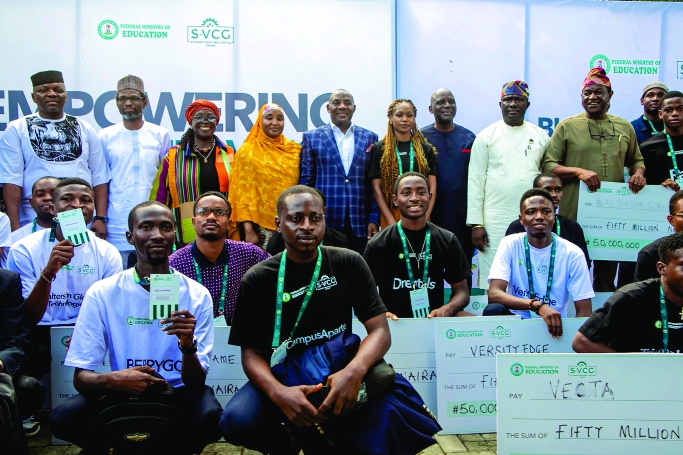
    ABUJA, NIGERIA, 30 March 2026 (NPA) — The Minister of Education, Dr Tunji Alausa, has expressed delight at the presentation of cheques totalling ₦2.2 billion in grants to 45 outstanding student ventures, recognising young Nigerians who are turning bold ideas into real solutions.

    The Minister said the recipients were the product of an “intense and inspiring S‑VCG Bootcamp,” noting that the journey began with over 30,000 applications from 404 tertiary institutions, narrowed down to 65 finalists, and culminating in 45 innovators emerging as winners from institutions across Nigeria.

    According to a statement on Monday, Alausa clarified that the winners came from federal, state, and private universities, with the majority from public institutions — “proof that talent and innovation exist in every corner of our country.”

    He added: “A moment that stood out for me was seeing 8 winners from the University of Lagos, many of whom came through our Entrepreneurship, Innovation & Business Incubation Certification (EIBIC) programme — a tried‑and‑tested pathway we are building to move students from ideas to real ventures. That is exactly the vision behind EIBIC: not just teaching entrepreneurship, but building founders, innovators, and builders.”

    “The Student Venture Capital Grant is more than funding — it is belief in the next generation. My sincere thanks to our panel of evaluators and judges, whose expertise and careful assessment helped identify these outstanding ventures. I am also deeply grateful to our partners, Bank of Industry, Afara Initiative and Elsie Attafuah of UNDP, for their support in making this programme a success.”

    While congratulating the 45 winners, the Minister also recognised the efforts of the 65 finalists, describing them collectively as “what the future of Nigeria looks like, and Nigeria’s next generation of innovators.”

  • Sett secures $30M to automate game marketing with AI agents

    Sett secures $30M to automate game marketing with AI agents

    MIDDLE EAST, 30 March 2026 (NPA) — Israeli startup Sett, which develops an AI agent–based platform for the gaming industry, has raised $30 million in a Series B round led by Greenfield Partners, with participation from existing investors F2 and Bessemer, bringing total funding to $57 million.

    The round also included Ben Feder of Tirta Fund, a prominent gaming executive and former CEO of Take-Two Interactive, developer of the Grand Theft Auto (GTA) series, as well as former president of Tencent’s gaming division.

    Founded in 2023, Sett is already generating tens of millions in revenue with strong growth rates, according to sources. Its customers include major gaming companies such as Zynga, Playtika and Papaya.

    While currently focused on gaming, Sett plans to expand into industries driven by performance-based marketing — including fintech, apps and e-commerce — by the end of 2026. The company believes its platform can act as a force multiplier, helping firms tackle increasingly complex marketing challenges.

    At its founding, Sett envisioned companies relying on autonomous AI agents to manage marketing operations. Initially, it focused on generating data-driven content and interactive ads for mobile gaming firms. Following early success, Sett is now developing a holistic user acquisition platform designed to manage player growth end-to-end, faster and more efficiently than traditional teams.

    User acquisition remains one of the largest cost centres for gaming companies, which spend billions annually. Marketing teams often produce hundreds of playable ads and thousands of video ads each month, a process that can take weeks manually. Sett says its platform cuts production times from weeks to hours and significantly reduces costs, saving companies millions while maintaining content quality.

    The company was founded by Amit Carmi (CEO) and Yoni Blumenfeld (CTO), both alumni of Unit 8200, and currently employs around 50 people. The new funding will accelerate product development and support global expansion.

  • NCC orders mobile operators to compensate subscribers for poor service

    NCC orders mobile operators to compensate subscribers for poor service

    ABUJA, NIGERIA, 30 March 2026 (Agency Report) — The Nigerian Communications Commission (NCC) has directed Mobile Network Operators (MNOs) to compensate subscribers in areas where service quality falls below prescribed standards.

    In a statement issued on Sunday in Abuja, Nnenna Ukoha, Head of Public Affairs at the NCC, said the Commission’s position was that consumers should not bear the full burden of service disruptions when operators fail to meet required benchmarks.

    Under the directive, affected subscribers will receive compensation in the form of airtime credits, calculated according to their average spending patterns and presence within Local Government Areas where service failures occur.

    Ukoha explained that the measure reflects the NCC’s consumer-centred regulatory philosophy, ensuring accountability while reinforcing the importance of consistent investment in network resilience, capacity expansion, and infrastructure upgrades.

    She emphasised that poor service quality undermines productivity, commercial activity, and public confidence in Nigeria’s communications system. While regulatory fines have traditionally served as deterrents, the Commission is now adopting a more consumer-focused approach to strengthen industry accountability.

    The directive also extends to tower companies, which own critical infrastructure for service delivery. Ukoha noted that the NCC will continue to deploy regulatory tools that promote fairness, transparency, and accountability across the sector, ensuring subscribers receive the quality of service they deserve while supporting Nigeria’s digital future.

  • Zelenskyy secures defence pact with Qatar as US-Israel-Iran war escalates

    Zelenskyy secures defence pact with Qatar as US-Israel-Iran war escalates

    INTERNATIONAL (NPA) — 28 March 2026 — Ukrainian President Volodymyr Zelenskyy has arrived in Doha as part of his country’s ongoing security support to Gulf states battered by waves of Iranian missile and drone attacks in the wake of the United States–Israel–Iran conflict.

    Ukraine, hardened by years of Russian aggression, has emerged as a sought-after partner in countering Iran’s cheap drone swarms across the Middle East. On Saturday, Zelenskyy met the Amir of Qatar, Sheikh Tamim bin Hamad Al Thani, with Prime Minister Sheikh Mohammed bin Abdulrahman Al-Thani also in attendance.

    Earlier, Zelenskyy was also in Saudi Arabia, where he met Crown Prince Mohammed bin Salman to discuss regional security cooperation and the strengthening of defence ties.

    In a statement, Zelenskyy confirmed that both sides agreed on a decade-long defence partnership. Chiefs of the General Staff signed an accord covering joint defence industry projects, co-production facilities, and technological collaboration between companies. “I provided an update on the security situation in Ukraine, the ongoing Russian attacks, and Russia’s close cooperation with the Iranian regime. Strengthening air defence is a priority for us, and we count on support from our partners,” Zelenskyy said.

    He expressed gratitude for Qatar’s warm reception and readiness to cooperate, describing the agreements reached as “concrete steps” towards protecting lives and enhancing regional security.

  • Vice President Shettima urges world-class standards for made-in-Nigeria products

    Vice President Shettima urges world-class standards for made-in-Nigeria products

    ABUJA, NIGERIA (NPA) — 27 March 2026 — Nigeria’s Vice President, Senator Kashim Shettima, has charged members of the National Council on Skills (NCS)—comprising federal ministries, state governments and the private sector—to ensure that Made-in-Nigeria products and services remain synonymous with world-class standards.

    He urged the council to harness the restless, inventive spirit of Nigerians, evident across streets, schools and workshops, by channelling this energy into powering the nation’s ongoing industrial revolution.

    In a statement on Friday, Shettima, who chaired the 8th NCS meeting at the Presidential Villa on Thursday, emphasised that as the council moves towards inaugurating the National Working Committee for WorldSkills Nigeria, its responsibility extends well beyond preparations for Shanghai 2026. He noted that the council’s work is central to positioning Nigeria as a hub of innovation and skills development in Africa.

    The 48th WorldSkills Competition, organised by WorldSkills International, will bring together skilled young professionals from across the globe to compete in diverse fields ranging from engineering and construction to information technology and creative arts. Nigeria’s participation, Shettima stressed, is not only about showcasing talent but also about benchmarking national standards against global best practices, thereby strengthening the country’s competitiveness in the international marketplace.

  • King Charles tours Oxford Photovoltaics, praises groundbreaking solar innovations

    King Charles tours Oxford Photovoltaics, praises groundbreaking solar innovations

    INTERNATIONAL (NPA) — 27 March 2026 — The King of England, His Majesty King Charles III, today visited Oxford Photovoltaics, a pioneering renewable energy company based at the Oxford Science Park in Oxfordshire. The firm, a spin‑out from the University of Oxford, has earned global recognition for its cutting‑edge work in solar technology, particularly in the development of perovskite solar cells.

    During the visit, the King described Oxford Photovoltaics as a trailblazing enterprise, noting that its advanced solar panels are capable of converting a broader spectrum of sunlight into clean, affordable energy compared with conventional models. This innovation positions the company at the forefront of efforts to accelerate the transition to sustainable energy both in the United Kingdom and internationally.

    According to a statement released by the Royal Family, His Majesty met members of staff, toured the company’s research and production facilities, and observed the technology in action. Oxford Photovoltaics, headquartered in Oxfordshire with additional operations in Germany, continues to expand its influence as one of Europe’s leading solar technology firms, combining academic research with industrial application to deliver solutions that address climate change and energy security.

  • Tony Elumelu’s Foundation commits $16m to empower 3,200 young African entrepreneurs

    Tony Elumelu’s Foundation commits $16m to empower 3,200 young African entrepreneurs

    LAGOS, NIGERIA (Agency Report) — March 24, 2026 — The Tony Elumelu Foundation (TEF) on Sunday unveiled 3,200 new beneficiaries of its 2026 cohort, each receiving a $5,000 empowerment grant for young African entrepreneurs.

    The Foundation said the entrepreneurs would be funded via Heirs Holdings Group Companies, the European Commission, Seme City Development Agency, DEG (German Development Agency), and the IKEA Foundation. Other partners include UNICEF, the Dutch Government, UNDP, and the Rwandan Ministry of Youth and Arts.

    Founder Tony Elumelu described the initiative as vital in providing access to funding, mentorship, coaching, training, and resources to catalyse businesses, drive job creation, and reduce poverty. “With policy clarity and commercial autonomy under President Bola Ahmed Tinubu’s leadership, NNPC Limited is positioned to pursue long-term, value-driven solutions,” he said, stressing that Nigeria remains a credible destination for energy and investment.

    TEF CEO Somachi Chris-Asoluka noted that since 2015, the foundation has disbursed over $100 million to 24,000 entrepreneurs, creating 1.5 million jobs, generating $4.2 billion in revenue, and lifting 3.1 million Africans above the poverty line. She added that 4.1 million households have been positively impacted.

    Chris-Asoluka said TEF will disburse $16 million to support, train, fund, and mentor the 3,200 selected entrepreneurs. Agriculture, retail, AI, ICT, green economy, recycling, education, and healthcare were highlighted as priority sectors.

    The event also introduced six high-achieving alumni from the Democratic Republic of Congo, South Africa, Kenya, Algeria, Mali, and Nigeria, who have transformed TEF’s support into leading businesses across Africa.