Category: Education

  • Lagos Governor Celebrates Esther Etiyemonu—Spelling Bee Champion and “One-Day Governor”

    Lagos Governor Celebrates Esther Etiyemonu—Spelling Bee Champion and “One-Day Governor”

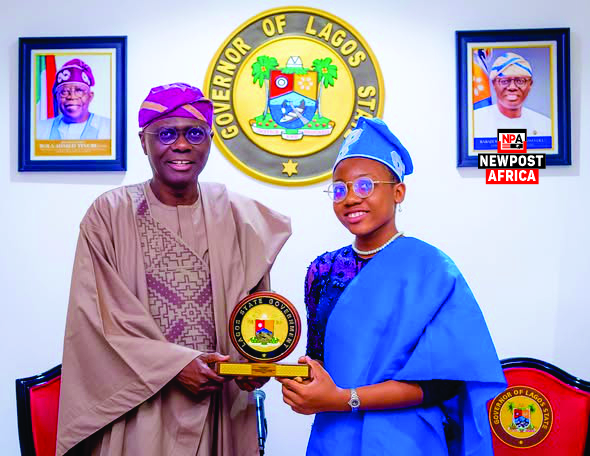
    LAGOS, NIGERIA — Governor Babajide Sanwo-Olu on Monday hosted Miss Esther Etiyemonu, the newly crowned One-Day Governor of Lagos State and overall winner of the 21st Lagos State Spelling Bee Competition, at Lagos House, Marina.

    In his remarks, Governor Sanwo-Olu praised Esther, a student of Lagos State Senior Model College, Igbokuta, describing her as “a brilliant student” whose confidence, focus, and hard work distinguished her in the statewide contest.

    “Today, I received Miss Etiyemonu Esther, the One-Day Governor and overall winner of the 21st Lagos Spelling Bee Competition, a brilliant student of Lagos State Senior Model College Igbokuta, at Lagos House, Marina. Her confidence, focus, and hard work stand out. She represents the very best of our youth, and I am incredibly proud of her achievements,” Sanwo-Olu said.

    He added: “Esther, all of Lagos is rooting for you and your bright future. Congratulations once again.”

    The Lagos State Spelling Bee Competition, inaugurated in 2001, produced its first One-Day Governor in Bisi Adeyemi. Since then, the tradition has continued, inspiring generations of Lagos students.

    Organized by the Lagos State Ministry of Basic and Secondary Education through the Office of Education Quality Assurance, the competition aims to promote literacy, language development, and academic excellence. Beyond spelling, it fosters confidence, leadership, and public speaking skills, with the highlight being the winner’s symbolic opportunity to serve as One-Day Governor of Lagos State — sitting in the Governor’s chair and experiencing leadership firsthand.

  • BREAKING: Fire outbreak at UNIZIK damages facility

    BREAKING: Fire outbreak at UNIZIK damages facility

    An early inferno has engulfed the Nnamdi Azikiwe University College of Health Sciences in Nnewi, Nigeria’s Southeast.  

    It was not clear what started the inferno and when, exactly. Residents of the academic community reportedly woke up to it.

    Emergency services have mobilised to the scene to contain the raging inferno.

    As of the time this report was filed, school authorities are still investigating the situation and have not yet determined the extent of the fire damage.  

    New Post Africa (NPA) earlier reported that President Bola Tinubu has dissolved the Governing Council of the Nnamdi Azikiwe University in Awka, and sacked the newly appointed Vice Chancellor of the institution, Professor Bernard Ifeanyi Odoh. Also sacked by the president is UNIZIK’s registrar, Rosemary Ifoema Nwokike.

    An error has occurred, which probably means the feed is down. Try again later.
  • Faulty Education Hindering Nigeria Progress—Peter Mbah

    Faulty Education Hindering Nigeria Progress—Peter Mbah

    The governor, while advocating for a rapid shift to experiential learning, expressed his disappointment that none of Nigeria’s universities rank among the world’s best and are unable to “produce inventive graduates who can drive national development.”

    T

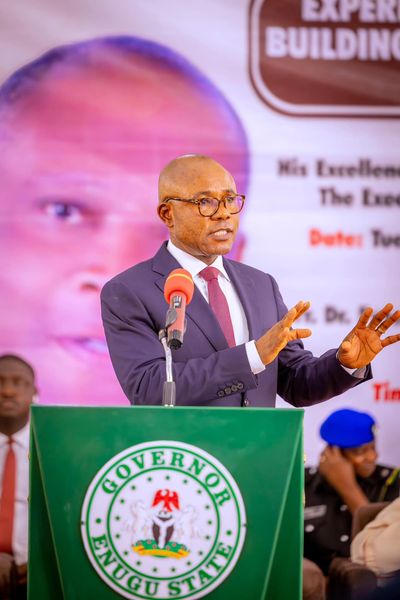
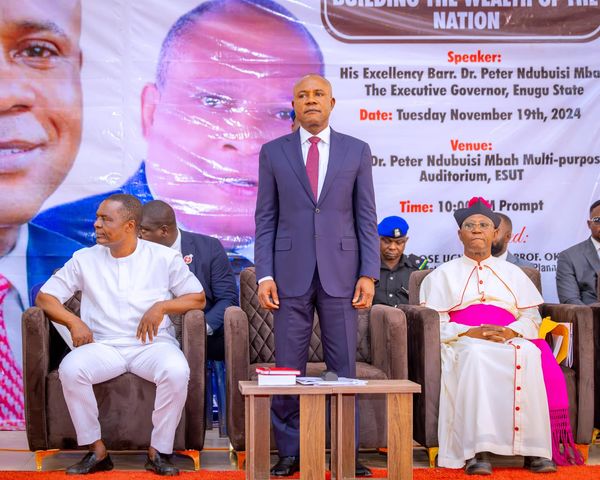
    he Governor of Enugu State, Dr Peter Ndubusi Mbah, on Tuesday, delivered the 1st Enugu State University of Science and Technology (ESUT) Distinguished Personalities Lecture Series. Building on the theme ‘Experiential Learning: Building the Wealth of the Nation,’ the governor observed the timeliness of the lecture to address the faulty model of education and learning in the country. A situation which he said “hindered our progress by failing to equip students with the skills and competencies required for industrialisation and economic transformation.”

    The governor, while advocating for a rapid shift to experiential learning, expressed his disappointment that none of Nigeria’s universities rank among the world’s best and are unable to “produce inventive graduates who can drive national development.”

    In the Enugu State education, he stated his ambition to transition it to education for a living by allocating 33% of the state’s budget to the sector, “twice UNESCO’s recommended benchmark. This investment has facilitated the creation of 260 Smart Green Schools across our wards.”

    The Enugu State Smart Green Schools target children from age three, instilling in them social habits, health habits, fine motor skills, and problem-solving competencies and introducing them to an experiential education system that helps them to navigate our rapidly evolving technological knowledge-driven world.

    “After three years of Early Childhood Education, having completed Nursery 1-3, our children complete Basic 1-9. During their twelve-year academic study in the Enugu Smart Green Schools, our children learn with interactive digital whiteboards, tablets, and computers; they are immersed in Robotics, Artificial Intelligence, Virtual/Augmented Reality, and the Internet of Things, among others,” he said.

    The Smart Green Schools graduates would proceed to “the eight Science, Technical, and Vocational (STV), which will focus on key competencies like Industrial and Information Technology, Building and Fabrication Engineering, as well as Industrial Agriculture,” to become respected and skilled professionals.

    Mbah also called on the state-owned tertiary institutions “to adopt experiential learning models in their planning, curriculum, and research efforts. Noting that “education is not just about passing exams,” but being prepared to take on the challenges of “a rapidly evolving, technology-driven world.”

  • 251 Million Children Out Of School Worldwide, UNESCO Reports, Africa Faces Greatest Challenges

    251 Million Children Out Of School Worldwide, UNESCO Reports, Africa Faces Greatest Challenges

    In low-income countries, 33 percent of school-aged children and youth are out of school, compared to just 3 percent in high income countries.

    Despite decades of educational progress and international commitments, a quarter of a billion children and youth remain out of school worldwide, UN education agency UNESCO’s latest Global Education Monitoring Report revealed on Thursday.

    The findings reveal that global efforts to ensure universal education have hit a concerning plateau, with the out-school population reducing by only 1 percent in nearly 10 years.

    “Education is the key driver of prosperous, inclusive and peaceful societies,” said UNESCO Director-General Audrey Azoulay. “Yet, quality education risks being the privilege of a few if we do not take serious measures to give every child across the globe the same chance to learn and thrive,” she added.

    While there has been progress in educational enrollment – with 110 million children entering school since the adoption of the UN Sustainable Development Goal on Education in 2015 – disparities remain persistent.

    The completion rates show improvement, with 40 million more young people finishing secondary school compared to 2015.

    However, the gap between rich and poor nations remains particularly alarming. According to the report, in low-income countries, 33 percent of school-aged children and youth are out of school, compared to just 3 percent in high income countries.

    The report highlighted that sub-Saharan Africa faces the greatest challenges, hosting more than half of all out of school children and adolescents globally.

    In a second report, the UNESCO-World Bank Education Finance Watch 2024, points to the chronic underinvestment as a primary obstacle. The disparity in education spending is striking, with the report revealing that high income countries invest $8,543 per learner while low- and middle-income countries manage only $55 per student.

    The situation is further complicated by debt burdens.  According to the report, in Africa, countries now spend almost as much on debt servicing as they do on education, while global education aid has declined from 9.3% in 2019 to 7.6% in 2022.

    In response, UNESCO, working alongside Brazil’s G20 presidency, is calling for innovative financing mechanisms, including debt-for-education swaps.

    “Equity and inclusion in and through education are fundamental to Brazil’s vision of social development,” said Brazil’s Education Minister Camilo Santana at the UNESCO Global Education Meeting in Fortaleza, where leaders are working to translate discussions into concrete actions to address this global education crisis.

  • Nigeria Government Reverses 18-Year Admission Age For Tertiary Institutions

    Nigeria Government Reverses 18-Year Admission Age For Tertiary Institutions

    ”We will not be going forward with the 18-years admission benchmark. We will go with 16 years and we are going to meet with JAMB and others on that. ”There will also be exception for the gifted students. 18-years is not part of our policy again.”

    The Minister of Education, Dr Tunji Alausa has reversed the decision of the past minister of education on the 18-years admission benchmark into tertiary institutions.

    Alausa spoke at his inaugural press briefing in Abuja on Tuesday. According to him, what led to that initial decision was the way the National Policy on Education was designed. ”We will not be going forward with the 18-years admission benchmark. We will go with 16 years and we are going to meet with JAMB and others on that. ”There will also be exception for the gifted students. 18-years is not part of our policy again,” he said.

    Addressing the withdrawal of certificates obtained from Benin Republic and Togo, Alausa stated that the policy would remain in place to help eliminate fake certificates from the system. Regarding the out-of-school children issue, he noted this as a key priority for the ministry, adding that various solutions would be considered to reduce their numbers. He said the ministry will collaborate with the Ministry of Humanitarian Affairs to provide conditional cash transfers as incentives for students to increase school enrollment.

    He also mentioned that nutritional programmes would be introduced to support students’ health, thereby enhancing human capital development. The News Agency of Nigeria reports that the Minister, along with the Minister of State for Education, Dr Suwaiba Ahmad, was officially welcomed by the Permanent Secretary, Dr Nasiru Sani-Gwarzo.

    (NAN)

  • Intensify Media Campaign Against FGM, Don Urges FG

    Intensify Media Campaign Against FGM, Don Urges FG

    Eserinune Mojaye, a Professor of Communication at the National Open University of Nigeria (NOUN), has urged the Federal Government to intensify campaign against Female Genital Mutilation (FGM) to protect the future of the girl-child. Mojaye made the call in Abuja at the 29th inaugural lecture of the university with the theme: “Constructing and Deconstructing Journalism Practice and Communication Research in Nigeria: A 40-Year Experience.

    He stressed the need for information and communication as the enduring solution to the problem. “Rather than legal prohibition, many studies have suggested that information and communication are more likely to provide an effective and enduring solution to the problem,” he said. The News Agency of Nigeria (NAN) reports that the United Nations Children’s Fund and the United Nations Fund for Population Activities rolled out a plan in 1997 to eliminate the practice of FGM within three generation. The plan emphasised the need for all governments in Africa to legislate against the practice and enforce national plans to it.

    Mojaye said that rather than using a legal approach to deal with the matter, governments at all levels should focus on using effective communication to address the matter. According to him, communication plays a vital role in health promotion and health education. He noted that effective communication empowers people to seek what is best for their health and to exercise their right of good quality health care. “Communication is also a vital tool in the promotion of behaviour change in all areas of health, including reproductive health. “In many countries of the world, communication has made open discussion about reproductive health issues possible.

    “However, in Nigeria, communication campaigns have not been well utilised in the crusade for the abandonment of FGM. “My studies on FGM show that the mass media have not been effectively used to inform and educate people on the dangers and health consequences of FGM. “As I found out in my studies, more impact would be made in the crusade for the abandonment of FGM if the mass media were used to disseminate messages and create awareness about the negative health consequences of the practice. “I, therefore, recommended in my studies that mass media messages, especially those aimed at informing and educating, should be an integral part of any effort to eradicate the practice of FGM,” Mojaye said. He noted that while communication had shaped how people conduct their daily lives, it had also transformed the lives of individuals and society at large.

    The Vice Chancellor of NOUN, Prof. Olufemi Peters, commended Mojaye for his vision, noting that communication could affect people’s way of living. Peters, who was represented by Prof. Isaac Butswat, Deputy Vice Chancellor, Administration, NOUN, said the lecture was a significant event in the professors’ career, where they share research, achievements and other engagements with the larger society. He assured that the institution would continue to invest in research and development of its workforce.

    (NAN)

  • 57 Bag First Class As Bingham Varsity Graduates 2,217

    57 Bag First Class As Bingham Varsity Graduates 2,217

    Bingham University, Karu, Nasarawa State, on Saturday graduated no fewer than 2,217 students with 57 hitting first class degrees. The News Agency of Nigeria (NAN), reports that at the institution’s 5th Convocation ceremony that comprised the 2022/2023 and 2023/2024 graduating sessions, 519 students got Second Class Upper Degrees

    NAN also reports that 576 students got Second Class Lower Degrees, while 179 and nine others got Third Class and Pass degrees respectively. Further details showed that 262 bagged MBBS, while postgraduate programmes produced 615  graduands comprising 41 Doctors of Philosophy (PhD), 156 Academic Masters,  298 Professional Masters, while 121 got Postgraduate Diplomas. The institution also conferred its first emeritus professor on Prof. Yakubu Alhasan.

    In his speech, the Vice Chancellor, Prof. Haruna Ayuba, said that the university had a spiritual heritage with diverse faculty members playing important roles in nurturing and shaping tomorrow’s leaders. “We nurture and shape young ones with the knowledge, skills and spiritual values that will make them change agents and globally-minded citizens. “The institution has 15 Faculties and 54 departments that run 40 undergraduate and 40 post-graduate programmes in the past nine years. “I commend the contribution of the past Vice-Chancellors; I commend their immense efforts towards the growth and development of the institution,” he said.

    Ayuba further said that the university had experienced a rapid growth in infrastructure with the construction of a befitting Senate Complex, as well as additional students’ hostels, laboratories, classes, among others. He said that the lifting of the ban on the first and second sets of law students that graduated in the 2021/2022 and 2022/2023 academic session by the Council for Legal Education, was a good development. “To the glory of God and in appreciation to the council, a total of 131 law graduates of Bingham University have all been mobilised to law school. “Induction of a total of 123 medical doctors by Medical and Dental Council of Nigeria (MDCN) in 2024 is also one other achievement we are so proud of,” he added.

    He, however, solicited for the support of stakeholders and guests to help raise standards and increased access to quality education in Nigeria. “There is an urgent need for construction of more students’ hostels to meet the growing student population; we need more buildings for the faculties, laboratories, classrooms and lecture halls. “There is also the need for the expansion of the ICT centre, provision of solar street lights in campus, additional paved road network, expansion of university health centres, among others. “Your support, individually and collectively, in addressing these challenges, will go a long way in helping us increase access to quality education. “This support will improve the learning environment for members of the university community,” he added.

    Also speaking, Retired Gen. Martin Agwai, the Special Guest, commended the stakeholders for the great role played towards raising the standard of Bingham University. “Today’s ceremony is significant because it marks both an ending and a new beginning for our graduands. “We are gathered to celebrate your achievement, acknowledge your hard work and share in the joy of your graduation. “I see a room filled with bright, ambitious and talented individuals, who will overcome challenges, embrace opportunities and transform dreams into reality,” he said. Dr Bagat Mallam, Chairman, Board of Trustees, said he was impressed with the group of young graduates. According to him, the young graduates will utilise the knowledge they gained in the university to better the world in their various fields of endeavours. “To the graduands, as you move up the ladder in your career, remember the ability to lead. “Also remember your personality, attitude, behaviours and interpersonal skills that will ultimately determine your level of success,” Mallam said. In his goodwill message, the Executive Secretary, National University Commission (NUC), represented by Mr John Mairafi, Director in the Executive Secretary’s office, commended the institution’s rapid growth.

    He applauded the institution’s outstanding records of many milestones, especially its capacity to produce 9,000 graduands and 80 programmes. He also recognised the pivotal role the university had played over the years with most of its programmes. He further explained that the commission had implemented curriculum standards and lurched programmes to enable more foreign collaboration, especially with Bingham University. The Pro-Chancellor of the University, Prof. Haruna Andrew, commended the vice chancellor for building on his predecessors’ visions and work. He encouraged the graduands to not just see themselves as graduates in caps and gowns, but the future leaders of the society. “You not only acquired knowledge and good character in Bingham, but have developed the necessary skills to navigate intricacies of the world beyond the walls of the university,” he said.

    The Chancellor, the Esu Karu, Mr Luka Panya-Baba, congratulated the institution and graduands and wished them more excellence. Appreciating the institution, the emeritus professor commended the graduands for coming thus far in their achievements. He encouraged the governing council of the school, Vice chancellor, colleagues in the academia and graduands, to keep the good works and be sure of greater heights. Graduands and parents, who spoke with NAN, could not hide their joy as they returned the glory to God and the institution. One of the graduands, Miss Sunshine Oche, from the Computer Science department, said she was thankful to God for the four years spent in the institution. Another graduand, Ezekiel Tochukwu, said he was happy to be among the graduating students, adding that spending four years in university was very challenging. He explained that the institution had impacted so much knowledge and morals into him and prayed it guides him in his future endeavours. A parent, Mrs Ijeoma Anyaji, mother to one of the graduands, explained that she could not express the inner joy she was feeling because she had, for years, anticipated the graduating day.

    According to her, training a child to graduate level is not an easy task either economically, financially and morally. She advised parents to always pray for their children/wards and also ask for divine wisdom in the upbringing of children. “That is the only way to have excellent children,” she said.

    (NAN)
  • Prioritise Education Over Strikes, Minister Urges Labour Unions

    Prioritise Education Over Strikes, Minister Urges Labour Unions

    Dr Tunji Alausa, Minister of Education, has appealed to labour unions in the sector to prioritise education over strike for the good and future of the Nigerian students. Alausa said this at the 359th Quadrennial National Delegates Conference of the Senior Staff Association of Nigerian Universities (SSANU) on Wednesday in Abuja. The theme of the conference was, “Respecting Collective Bargaining Agreements and Industrial Peace in a Democracy”.

    He said that industrial action should not be the first line option in seeking government”s attention to the unions’ demands. “I know you as an association, together with the Academic Staff Union of Universities (ASUU), Non Academic Staff of Universities(NASU),. collectively, your psyche has been affected. “The government has gone into agreement with you, and most of the time, the government has not fulfilled their own part of the agreement. “But let me promise you this, President Bola Tinubu is a democrat, he will work to meet his obligation and agreement that he enters with you.      “Let us prioritise the future of our children and work together to keep them in school,” he said.

    Alausa also said that the government was constrained by certain financial limitations like heavy expenditures by the previous administration on subsidies and artificially low exchange rates. He said that these policies had drained the country’s resources and benefitted the wealthy at the expense of crucial sectors like education. “Subsidies cost Nigeria nearly one billion dollars daily, while artificially maintaining the exchange rate added another 500 million dollars monthly. “These unsustainable practices took resources away from critical sectors,”he said. He urged the labour unions to give the government the benefit of the doubt and engage in collective bargaining with mutual respect. “We have assembled a committee led by respected Nigerians, including Alhaji Yayale Ahmed, former Head of Service, to negotiate with unions,” he said.

    Also, Mr Ayuba Wabba, Former President of Nigeria Labour Congress (NLC) said that labour unions’ were frustrated by repeated breaches of agreements with the federal government. “Failure to honour collective bargaining agreements has been a major source of strikes in Nigeria,” he said. Wabba called for establishment of a Labour Council, similar to South Africa’s model, that would facilitate quarterly meetings between government and union representatives. He added that this would help in addressing the emerging issues proactively and fostering trust. Mr Mohammed Ibrahim, National President of SSANU, called for a shift in perceptions around unions. Ibrahim said that SSANU and other unions were often mischaracterised as “strike-happy” and called for a new narrative that promotes industrial peace

    (NAN)

  • Nigeria Navy Inaugurates School In Niger Village

    Nigeria Navy Inaugurates School In Niger Village

    The Nigerian Navy has inaugurated Major I. E. Muazu Memorial Primary School in Adunu community in Paikoro Local Government of Niger State. Vice Admiral Emmanuel Ogalla, Chief of Naval Staff (CNS), inaugurated the project in Adunu on Thursday. Ogalla, represented by Rear Admiral Julius Nwagu, Acting Chief of Naval Transformation, said the project was a civil-military engagement, aimed at fostering harmonious relations between the Navy and local communities.

    Ogalla said the project was executed under the CNS Special Intervention Quick Impact Project Scheme in honour of Rear Admiral Istifanus Mua’zu -Albara, Flag Officer Commanding Naval Training Command. “We decided to encourage every Rear Admiral in Nigeria Navy to initiate projects that will benefit their communities; we have over 15 CNS-sponsored projects nationwide. “The rear admirals are to identify critical quick impact projects that will have maximum impact on the socio-economic wellbeing of grassroots communities,” he said. He said provision of infrastructure for early educational training was key to emancipating illiteracy and poverty, adding that through the project, children would have access to quality education.

    Ogalla added that the renovated school, benefiting over 118 children, symbolised hope and opportunity for youths in Paikoro Local Government. In his welcome address, Mua’zu-Albara, disclosed that Major I.E. Muazu Memorial Primary School started as a missionary school in the early 50s. He disclosed that the project was a two new classroom blocks consisting of five classrooms, two offices as well as three renovated blocks of classrooms. He added that the project included the construction of a perimeter fence for the school, construction of a security post in line with the safe school initiative. According to him, others are modern toilet facilities, furniture for the classrooms/offices along with provision of solar powered lightning units within the school premises. Mua’zu-Albara said the project would address infrastructure deficit in the community and elevate its educational standard, foster a deeper connection between the community and the armed forces.

    In his remarks, Gov. Umaru Bago of Niger, emphasised the need for collective support to revamp the educational sector. Bago, represented by Hajiya Hadiza Mohammed, Commissioner for Basic and Secondary Education, called on council chairmen to take ownership of school properties, given their deteriorated condition statewide. He said as products of public schools, they should ensure institutions does not fall short of expectation and urged all stakeholders to collaborate and take charge. The District Head of Adunu, Alhaji Kabiru Bawa, thanked Bago for addressing security concerns in the area enabling residents to sleep peacefully. He commended the Navy for the new facility and called on the state government to intervene on the deplorable Kafin-koro-Adunu road and the restoration of electricity in Adunu community.

    (NAN)

  • Regalo Hope Foundation Organises Quiz Competition For Secondary Schools

    Regalo Hope Foundation Organises Quiz Competition For Secondary Schools

    This will help bring knowledge in the classroom, not just on the surface, but also sharpen their general knowledge, improve their vocabularies, and help them to embrace their national values by understanding current affairs.

    The Regalo Hope Foundation (RHF) has organised a Quiz Competition for students in secondary schools across Lagos state, as part of activities to herald the 2025 EduStake Conference aimed at advancing education. The competition, which had over 25 schools from public and private sectors, held on Wednesday at the Lagos Theatre, Igando, and featured Spelling Bee and Current Affairs competitions. The News Agency of Nigeria (NAN) reports that five schools emerged tops in the stages of the competition, to advance and compete for cash prizes at the finals stage on Jan. 24, 2025. The top five schools include Stadem Comprehensive College Igando, Egan Senior Grammar School, Egan-Igando; Akesan Community Junior Grammar School, Akesan-Igando; Grimes International College, Subaru-Oje, all in Lagos and DeGate of Wisdom Model School, Itele-Awori Ota, Ogun state. Mrs Chinenye Onuorah, Founder and Project Manager of RHF, in her address, said the initiative was to rebrand education and restore the passion whereby students would have full grip of spellings, current affairs and know their vocabularies.

    According to her, the essence of the preliminary competition ahead the 2025 EduStake Conference, is to bring back spelling knowledge and searching of words in dictionaries. “This will help bring knowledge in the classroom, not just on the surface, but also sharpen their general knowledge, improve their vocabularies, and help them to embrace their national values by understanding current affairs. “Like today, some don’t know their ministers and state slogan. Students no longer have passion for spellings and have limited knowledge of current affairs because of technologies and use of devices. ”That is part of what this competition is trying to instill. “The prize at the 2024 edition for winners was N250,000, 1st: N150,000 2nd position and 3rd position got N100,000”.

    On the cash prizes in the 2025 edition, Onuorah assured that the prize would be more. She solicited for more sponsorship. In her remarks, Mrs Olabisi Abiodun, Head of Department (HOD), Education Library Services, Igando/Ikotun LCDA, applauded RHF for the programme describing it as, “more of enlightenment than competition”. Abiodun urged the students to take advantage of such engagements to gain more knowledge. She said: “Never gain knowledge for nothing, but use it to transform yourself and the society. “Take cognisance of the five pillars of education, which are- learn to know, your right, learn to do ‘activate’ what you learnt, learn to.live together as an entity, learn to be (not to have inferiority complex) and lastly, learn to transform,” she added.

    Abiodun was represented at the event by Mr Ojo Adekunle, Secretary, Education Library Services, Igando/Ikotun LCDA. Also, Mr Raheem Akeem, the youth Leader of Igando/Ikotun LCDA, while lauding the organisers of the programme, urged parents to complement the effort of RHF and be actively involved in their children’s academics.

    Earlier, Mr Nnamdi Onuorah, Chairman, Board of Trustees of RHF, said the foundation was committed to using the platform to bring out the best in students, for them to become the desired sound leaders of tomorrow. “By my own assessment of the participants, the students are making progress but there is room for improvement. “The gain or benefit of the programme is that the questions and answers have added to their knowledge. “There is need to keep track of basic foundation. Those days, we used to have dictations, literary and debating activities which spurred us to research more, unlike today that devices have taken over. “RHF is supporting our education system through this quiz because we believe that it will further encourage and promote their self-esteem, make them have versatile knowledge and build their capacity,” he added. Meanwhile,

    OreOluwa Abiodun, Partnership and Communication Strategist, RHF, said that the EduStake, an annual conference by the foundation, was organised to bring together education stakeholders. Oreoluwa added that the event would engage parents, teachers, students community leaders and government officials to discuss and enhance the course of education in Nigeria. “The EduStake will also feature RHF Legend Award (for teacher or educator with over 25 years experience) and Heroes Award (top three who enrolled in RHF Teachers Leadership Academy), including cash prizes,” she added.

    (NAN)