

WHO chief visits Ebola-hit Ituri, urges stronger coordination and research on Bundibugyo virus
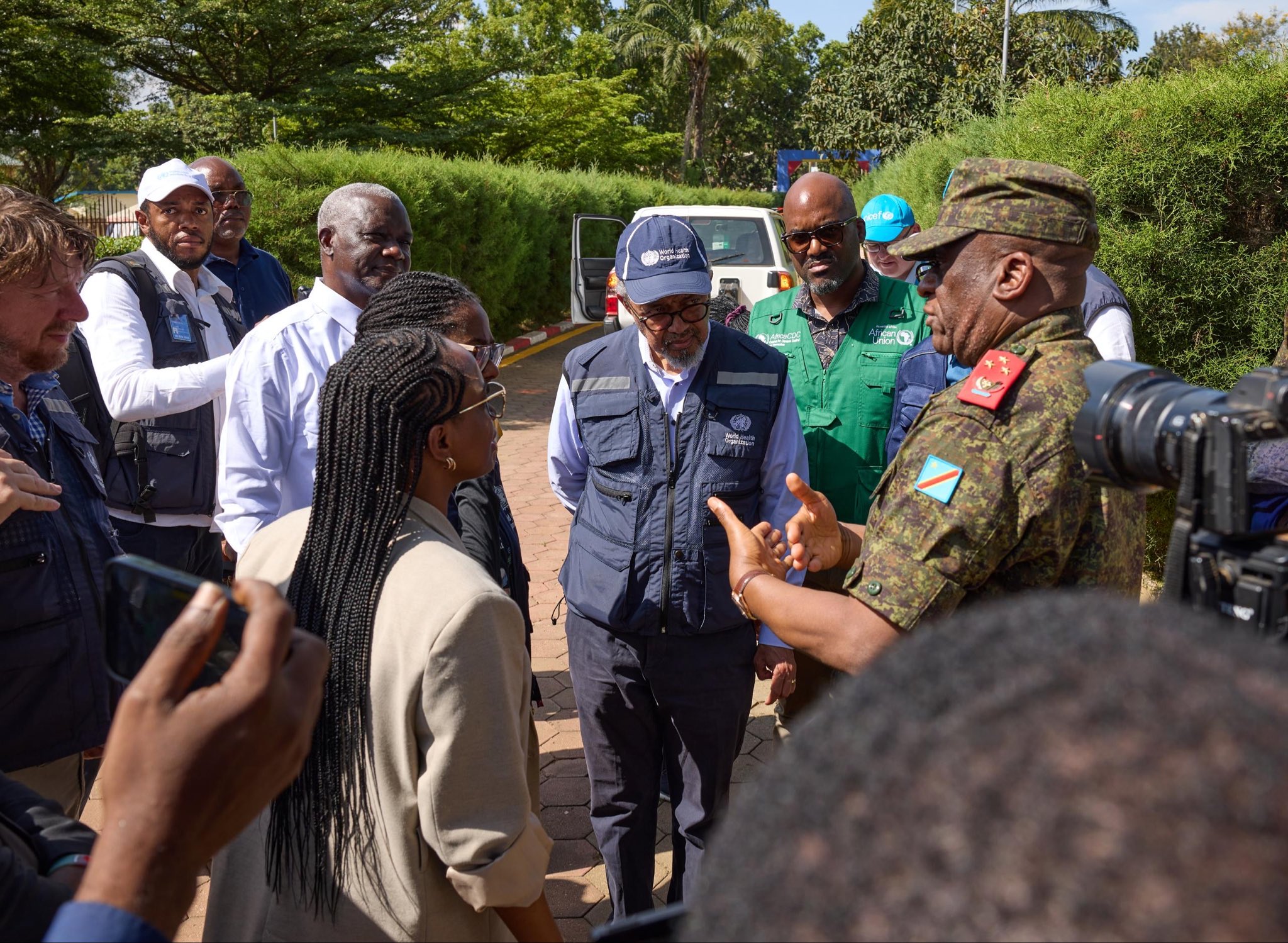
KINSHASA, DRC (NPA) — The Director-General of the World Health Organisation (WHO), Tedros Adhanom Ghebreyesus, has visited Ituri Province in the Democratic Republic of Congo, the epicentre of the latest Ebola outbreak caused by the Bundibugyo virus.
During his mission, Ghebreyesus met with Lieutenant-General Johnny Luboya Nkashama, Governor of Ituri, praising his leadership amid a crisis complicated by internal conflict and mass displacement.
“I want to express my appreciation for his strong leadership during this complex crisis,” Ghebreyesus said, stressing that enhanced coordination among health and humanitarian actors is critical to containing the outbreak.

He emphasised the importance of listening to and supporting local communities, noting that residents are best placed to articulate their needs and identify effective solutions. WHO assessed the outbreak risk as very high nationally, high regionally, but low globally, and advised against imposing travel or trade restrictions on the DRC and Uganda.
In Geneva, WHO convened expert groups to evaluate candidate treatments and vaccines for Bundibugyo virus disease (BVD). While no licensed therapeutics or vaccines currently exist, several promising options were prioritised for clinical trials.
For treatment, experts recommended evaluating monoclonal antibodies MBP134 and Maftivimab®, as well as the antiviral remdesivir, including combination therapy. For prevention, the oral antiviral obeldesivir was identified as a candidate for post-exposure prophylaxis, though effective contact tracing remains a challenge.
On vaccines, the single-dose rVSV Bundibugyo vaccine (developed by IAVI) could be ready for trials within 7–9 months, while ChAdOx1 Bundibugyo (Oxford/Serum Institute of India) may be available in 2–3 months pending additional animal data. WHO also reviewed Ervebo, the only licensed Ebola vaccine, but concluded it should not be used outside research settings due to limited evidence of cross-protection.
WHO stressed that all research must adhere to the highest ethical standards, under national leadership and with community consultation. In the meantime, the priority remains stopping transmission through proven tools: surveillance, rapid testing, contact tracing, isolation, patient care, infection control, community engagement, and safe burials.
“Together for health. Stand with science,” Ghebreyesus said, reaffirming WHO’s mission to protect vulnerable populations and accelerate access to effective countermeasures.
Ghana, UK review bilateral ties ahead of Mahama’s official visit
Nigeria, Ethiopia deepen cooperation on trade and investment

World Bank upgrades Africa growth outlook, says AI could boost jobs and productivity
Uganda vaccinates more than 8.2 million children in Measles-Rubella Campaign
NCDC heightens vigilance after imported Ebola case confirmed in Kenya
Eswatini says three third-country nationals voluntarily return home
NAFDAC DG advocates stronger continental cooperation on food safety
AU Commission Chairperson congratulates Abiy Ahmed on re-election
- Tinubu commissions NRS Headquarters, says new tax reforms will drive prosperity
- Tinubu assures investors of regulatory stability as Ogun, DP World sign $7bn port, SEZ MoUs
- Climate change anxiety is rising — and so is the willingness to act on it
- Ohaukwu LG Chairman Ituma breaks ground for modern diagnostic centre, blood bank
- Baseball boosts TBS, NFL gives ESPN a kick and streamers love ‘Squid’
Community Discussion