Category: Politics

  • BIAFRA: Simon Ekpa’s Extradition Almost Impossible —Vince Onyekwelu

    BIAFRA: Simon Ekpa’s Extradition Almost Impossible —Vince Onyekwelu

    A

    former British Police Officer and National Security Risk Strategist has cautioned Nigeria not to be optimistic about the extradition of Simon Ekpa. This follows the raging media storm over his arrest by the Finish authorities, with the Nigeria military pushing for his extradition to face yet-to-be-calibrated criminal charges.

    Speaking on Arise News, on Friday, monitored by New Post Africa, Onyekwelu said he is not convinced that the extradition will happen soon because there is no treaty between Nigeria and the Scandinavian country in that aspect.

    “Professionally speaking, the Finnish Authorities have done their due diligence and they have every reasonable ground to arrest Mr Simon Ekpa,” he said.

    On what we determine if his extradition will happen or not, he opined that the matter is “now left for the court in Finland to now look into the request by the Chief of Defence Staff to extradite Simon Ekpa to Nigeria. Professionally speaking, the chances are possible to extradite Simon Ekpa. However, in my opinion, it is almost, almost impossible,” he reiterated.

    Further assessing the complexity of the situation, he stated that the case will go through the European Union Criminal Justice system. Because Ekpa is a citizen of the EU and will defend himself and the reason he is fighting for self-determination for Biafra.

    The security expert also accessed the human rights records of Nigeria, describing it as “nothing to boast about,” and cited instances of several alleged human rights abuses in the country and the latest alleged abuse of a couple by officers of the Nigeria military in the Nigeria’s capital, Abuja. All of which he said can weaken Ekpa’s extradition request.

    The man, Simon Ekpa, born on March 21, 1985, is a member of the ruling National Coalition Party of Finland. Since 2022, he and his Biafran Republic Government in Exile, which he serves as its Prime Minister, have actively propagated the restoration of the Biafran Republic from his base in Finland.

    In the last two years, following the arrest of Mazi Nnamdi Kanu, the leader of the Indigenous People of Biafra (IPOB) in Kenya and his detention at the Nigeria spy police facility in Abuja, Ekpa has taken the centre stage of the Biafran movement. Unlike Kanu, his approach to the struggle has been offensive. His sit at home orders has been of great concern to the authorities, who accused him of creating insecurity and destabilising the southeast region, which he denies.

  • Sanwo-Olu presents 3 trillion Budget of Sustainability to House of Assembly

    Sanwo-Olu presents 3 trillion Budget of Sustainability to House of Assembly

    L

    agos State agos State Governor, Babajide Sanwo-Olu, on Thursday, presented the state’s 2025 budge to the House of Assembly. The financial plan totalling N3.005 trillion is the biggest ever in the history of Nigeria’s southwest state and the commercial epicentre of the country.

    The total figure in the 2025 budget represents a 32.5% increase from the 2024 budget of N2.3 trillion

    While explaining key financial elements in the document, the governor noted that N908.7 billion is allocated to capital investment, covering areas such as tourism, agriculture, transportation, and deepening of the infrastructure revamping and modernisation drive of the state for sustainable development.

    Besides infrastructure sustainability, economic diversification, social inclusion, human capital development, and environmental sustainability also received robust financial attention in the budget in response to the global climate change crisis.

    The Governor also praised his administration’s performance in many sectors of the economy and road construction, announcing that his administration would commission soon 30 road projects and bridges. He also mentioned a partnership with “the Federal Government to initiate the development of the 68-km Green Line, connecting Marina to the Lekki Free Trade Zone.”

  • 40 Killed In Sudan War Between Government and RSF Forces

    40 Killed In Sudan War Between Government and RSF Forces

    The latest killing is a reminder that the conflict in Sudan is far from over and a need for an urgent peaceful resolution.

    A suspected attack by the Rapid Support Forces (RSF), a Sudanese paramilitary force, has reportedly left 40 people dead, a medic told AFP from a central Sudan village.

    “All 40 people suffered direct gunshot wounds,” the medic from Wad Rawah Hospital, north of Wad Oshaib village in Al-Jazira State, who requested anonymity over safety concerns, said.

    “The attack resumed this morning,” one eyewitness told AFP by phone on Wednesday, adding that fighters were “looting property.

    The conflict between the Rapid Support Forces (RSF) and the Sudanese army stems from a power struggle that began in April 2023. The RSF, led by General Mohamed Hamdan Dagalo (also known as Hemedti), and the Sudanese army, led by General Abdel Fattah al-Burhan, have been vying for control over the country’s major institutions1.

    The fighting is primarily about control over the country’s political and military institutions, with both sides accusing each other of initiating the conflict.

    The conflict has caused a dire humanitarian crisis, with thousands of civilians killed and millions displaced. Hospitals and other critical infrastructure have been targeted, exacerbating the suffering of the people of Sudan.

    The international community, including the United States, has condemned the violence and called for a ceasefire. Efforts to mediate peace talks are ongoing, but the situation remains volatile and unpredictable.

  • Somaliland opposition leader Cirro wins in presidential election, beating incumbent

    Somaliland opposition leader Cirro wins in presidential election, beating incumbent

    Reuters—Somaliland opposition leader Abdirahman Cirro defeated incumbent president Muse Bihi Abdi in last week’s election, the electoral commission said on Tuesday, setting up a handover of power as the breakaway Somali region pushes for global recognition.

    Somaliland has had de facto self-rule since declaring independence from Somalia in 1991, but has not been recognised by any country, restricting access to international finance and the ability of its six million people to travel.

    Cirro, leader of the opposition Waddani party, won 64% of the vote against Bihi’s 35%, said Musa Hassan, chairman of the Somaliland Electoral Commission.

    “This election is not a win or loss for the candidates. It was an election of unity and fraternity and pushing ahead the Somaliland nation,” Cirro said in a televised address on Tuesday.

    Occupying a strategic location at the juncture of the Indian Ocean and Red Sea, Somaliland sees international recognition as being within reach after signing a preliminary deal with landlocked Ethiopia in January that would grant Addis Ababa a strip of land on its coast in exchange for recognition.

    Somaliland is also hopeful that the incoming U.S. administration of President-elect Donald Trump will be favourable to its cause. Several leading Africa policy officials from Trump’s first term have voiced support for its recognition.

    The breakaway region has enjoyed a comparative period of peace since achieving autonomy three decades ago, just as Somalia plunged into a civil war from which it has yet to emerge.

    While Cirro has signalled broad support for the proposed pact with Ethiopia, his commitment to implementing it is not clear. Some analysts suspect he could be more open to dialogue with Somalia’s government, which opposes the agreement.

    The deal has soured Somalia’s relations with Ethiopia, a major contributor towards a peacekeeping force in Somalia fighting Islamist militants, and drawn Somalia’s government closer to Ethiopia’s historic rivals, Egypt and Eritrea.

    The presidents of Somalia and neighbouring Djibouti, whose relations with Somaliland were also strained under Bihi, congratulated Cirro on his win.

    Ethiopia’s foreign ministry also sent a congratulatory message to Cirro.

    “Congratulations to the newly elected President of Somaliland… and to the brotherly people of Somaliland for their political maturity,” Djibouti’s president, Ismail Omar Guelleh, wrote on X.

    In his message, Somali President Hassan Sheikh Mohamud committed to ongoing reconciliation talks, which he said were focused on preserving the unity of Somalia.

    “While I think there are concerns that (Cirro) may opt for a radical departure from his predecessor, jettison the MOU (deal with Ethiopia), embrace dialogue with Somalia, there’s a big difference between campaigning and governing,” said Matt Bryden, a strategic adviser with the Sahan think tank.

    Cirro’s victory could also signal closer ties with China, a major investor in the Horn of Africa.

    According to Somali media reports, Cirro has in the past questioned the value of Somaliland’s ties with Taiwan, which China sees as part of its territory, in its quest for recognition.

  • Faulty Education Hindering Nigeria Progress—Peter Mbah

    Faulty Education Hindering Nigeria Progress—Peter Mbah

    The governor, while advocating for a rapid shift to experiential learning, expressed his disappointment that none of Nigeria’s universities rank among the world’s best and are unable to “produce inventive graduates who can drive national development.”

    T

    he Governor of Enugu State, Dr Peter Ndubusi Mbah, on Tuesday, delivered the 1st Enugu State University of Science and Technology (ESUT) Distinguished Personalities Lecture Series. Building on the theme ‘Experiential Learning: Building the Wealth of the Nation,’ the governor observed the timeliness of the lecture to address the faulty model of education and learning in the country. A situation which he said “hindered our progress by failing to equip students with the skills and competencies required for industrialisation and economic transformation.”

    The governor, while advocating for a rapid shift to experiential learning, expressed his disappointment that none of Nigeria’s universities rank among the world’s best and are unable to “produce inventive graduates who can drive national development.”

    In the Enugu State education, he stated his ambition to transition it to education for a living by allocating 33% of the state’s budget to the sector, “twice UNESCO’s recommended benchmark. This investment has facilitated the creation of 260 Smart Green Schools across our wards.”

    The Enugu State Smart Green Schools target children from age three, instilling in them social habits, health habits, fine motor skills, and problem-solving competencies and introducing them to an experiential education system that helps them to navigate our rapidly evolving technological knowledge-driven world.

    “After three years of Early Childhood Education, having completed Nursery 1-3, our children complete Basic 1-9. During their twelve-year academic study in the Enugu Smart Green Schools, our children learn with interactive digital whiteboards, tablets, and computers; they are immersed in Robotics, Artificial Intelligence, Virtual/Augmented Reality, and the Internet of Things, among others,” he said.

    The Smart Green Schools graduates would proceed to “the eight Science, Technical, and Vocational (STV), which will focus on key competencies like Industrial and Information Technology, Building and Fabrication Engineering, as well as Industrial Agriculture,” to become respected and skilled professionals.

    Mbah also called on the state-owned tertiary institutions “to adopt experiential learning models in their planning, curriculum, and research efforts. Noting that “education is not just about passing exams,” but being prepared to take on the challenges of “a rapidly evolving, technology-driven world.”

  • Soludo Presents 2025 Budget To House, Gains Of Previous Years

    Soludo Presents 2025 Budget To House, Gains Of Previous Years

    Prof. Charles Chukwuma Soludo CFR, the Executive Governor of Anambra, on Tuesday, presented the draft copy of the state’s 2025 fiscal year budget estimate of ₦606.9 Billion to the State House of Assembly. The document titled Changing Gears 2.0 represents a 48.0% increase from the last year’s N410,132,225,272 budget size.

    In the financial document, recurrent expenditures (77% of the total budget) account for N139.5 billion while capital expenditures got N467.5 billion (23%). While the budget deficit, estimated at N148.3 billion, is to be funded through revenue growth or borrowing from financial institutions.

    The governor in his presentation clarified that in both 2023 and 2024, the state did not borrow to finance budget deficits and a pointer that it might not borrow to fund any deficit in the 2025 budget. He hinged the success “on transparency, accountability, and sustainability.”

    Soludo also pointed out that “relative to 2024, several key sectors are seeing significant increases: the administrative sector by 45.5%; the Economic sector by 40.1%; the Judiciary sector by 51.3%; the social sector by 82.7%; Education by 101.4%; Health by 57.1%; and Infrastructure investment by 38.9%. Also, the state is “building upon the iconic projects initiated in 2024 while introducing new ones. Infrastructure and economic transformation as well as human capital development remain the kernel of this administration, and, significantly, at least 70% of the budget is allocated to these sectors.”

    While giving a status report on the development of three new cities: Awka 2.0, Onitsha 2.0, and a new Industrial City, he revealed that the Anambra Mixed-Use Industrial City Master Plan and the railway master plan/feasibility study have been completed in which the state is partnering with Afreximbank and AFDB in the development of an Industrial City.

    The governor reiterated his commitment to enhance the Ease of Doing Business in Anambra “to ensure the State becomes the preferred destination for investors.”

    Other projects to be implemented in the 2025 budget include the building of the largest shopping mall in Africa and the development of leisure centres throughout the State, investments in mass transit systems and marine transport, including buses, jetties, and boats and rural electrification projects and water projects, human capital development, education, seedlings to farmers and youth skills acquisition programmes.  

  • Major Ugandan Opposition Politician Kidnapped In Kenya

    Major Ugandan Opposition Politician Kidnapped In Kenya

    His kidnap follows the same pattern as that of Mazi Nnamdi Kanu, the leader of the Indigenous People of Biafra (IPOB), controversially arrested in Kenya and brought back to Nigeria in June 2021. Allegations of illegal detention and torture surrounded his arrest and subsequent extradition.

    Winnie Byanyima, the wife of Kizza Besigye, a prominent Ugandan opposition politician, has raised an alarm over his kidnap in Kenya over the weekend and transfer to a military detention centre in Kampala, the Ugandan capital. According to her, the kidnap happened after the politician participated in a book engagement in the east African country.

    While calling for her husband’s release, she said: “I request the (government) of Uganda to release my husband Dr Kizza Besigye from where he is being held immediately. I am now reliably informed that he is in a military jail in Kampala. We his family and his lawyers demand to see him. He is not a soldier. Why is he being held in a military jail?”

    In response to a request by Reuters, the Ugandan military and police denied knowing the whereabouts of the politician, who contested against Ugandan President Yoweri Museveni in four consecutive elections and lost in all.

    Kizza Besigye is a prominent Ugandan opposition politician and physician. He was born on April 22, 1956, in Rukungiri, Uganda. He served as the personal physician to President Yoweri Museveni during Uganda’s guerrilla war, but later became a vocal critic and political opponent of Museveni, after they fell apart.

    He contested the Ugandan presidency in 2001, 2006, 2011, and 2016), and accused the government of denying him victory. 

    The president of the Forum for Democratic Change (FDC), a Human Rights Activist, has been arrested and detained several times over the years.

    His kidnap in Kenya follows the same pattern as that of Mazi Nnamdi Kanu, the leader of the Indigenous People of Biafra (IPOB), who was also controversially arrested in Kenya and brought back to Nigeria in June 2021. Allegations of illegal detention and torture have surrounded his arrest and subsequent extradition.

    Kanu was reportedly detained in Kenya for eight days under harsh conditions before being handed over to Nigerian authorities.

    The Nigerian government has faced criticism for the manner in which Kanu was extradited, with claims that it violated international laws and due process. Despite these controversies, Kanu remains in detention in Nigeria, facing charges related to terrorism and treason.

  • Seven NSCDC Officers Missing After Boko Haram Ambush

    Seven NSCDC Officers Missing After Boko Haram Ambush

    Seven officers of the Nigeria Security and Civil Defence Corps (NSCDC), a paramilitary agency in the country that protects lives and property, and safeguards critical national infrastructure, have been declared missing following an attack by suspected Boko Haram militants.

    In a statement, NSCDC spokesperson, DCC Afolabi Babawale, said the attack on the officers happened on Monday in the Farin-Kasa area of Chukun Local Government Area, Kaduna State when the operatives were inspecting the National Grid installation from Shiroro in Niger State. He further explained that, due to the recent increase in attacks on power lines that have plunged the country into darkness, the nine officers and 71 others who were ambushed had been deployed to police the power infrastructure in the area.  

    He also disclosed that “as they patrolled vulnerable areas, the officers “encountered stranded expatriates near Dagwachi Village and allowed them to join the convoy for safety. Unbeknownst to the team, over 200 armed Boko Haram militants had laid a deadly ambush from a hilltop, ready to unleash a torrent of gunfire on the unsuspecting convoy.”

    “Determined and resourceful, the NSCDC operatives fought back valiantly, managing to neutralise over 50 insurgents during the exchange. However, the chaos left seven officers unaccounted for, prompting an urgent search in the bush for their whereabouts. Those who sustained injuries are currently receiving medical treatment.”

    The NSCDC Commandant-General, Ahmed Audi, who praised his men for their gallantry and service to the nation, described that attack as cowardly against personnel committed to the nation’s defence and protection of critical national infrastructures.

    Recall that reports of suspected Boko Haram militants allegedly occupying a swathe of territory and making an incursion into a military training ground in Niger State, which was denied by the Nigeria Military, made rounds in the media recently. This recent attack by the Islamic militant group, officially known as Jamā’at Ahl as-Sunnah lid-Da’wah wa’l-Jihād, adds to their internationally acclaimed notoriety for its brutal tactics, including mass kidnappings, bombings, and assassinations since 2002. Despite efforts by regional and international forces to combat the group, Boko Haram remains a significant threat in Nigeria and across the Sahel region.

  • 251 Million Children Out Of School Worldwide, UNESCO Reports, Africa Faces Greatest Challenges

    251 Million Children Out Of School Worldwide, UNESCO Reports, Africa Faces Greatest Challenges

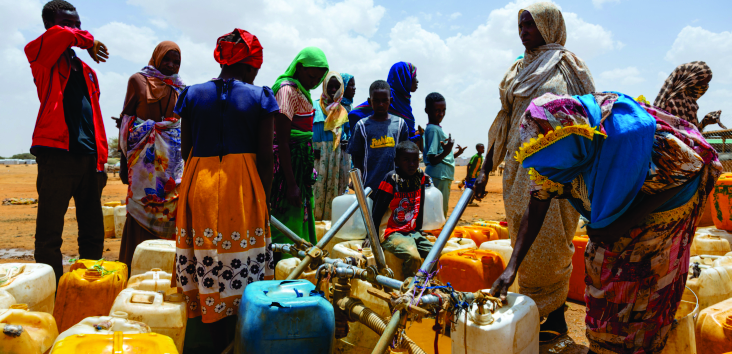
    In low-income countries, 33 percent of school-aged children and youth are out of school, compared to just 3 percent in high income countries.

    Despite decades of educational progress and international commitments, a quarter of a billion children and youth remain out of school worldwide, UN education agency UNESCO’s latest Global Education Monitoring Report revealed on Thursday.

    The findings reveal that global efforts to ensure universal education have hit a concerning plateau, with the out-school population reducing by only 1 percent in nearly 10 years.

    “Education is the key driver of prosperous, inclusive and peaceful societies,” said UNESCO Director-General Audrey Azoulay. “Yet, quality education risks being the privilege of a few if we do not take serious measures to give every child across the globe the same chance to learn and thrive,” she added.

    While there has been progress in educational enrollment – with 110 million children entering school since the adoption of the UN Sustainable Development Goal on Education in 2015 – disparities remain persistent.

    The completion rates show improvement, with 40 million more young people finishing secondary school compared to 2015.

    However, the gap between rich and poor nations remains particularly alarming. According to the report, in low-income countries, 33 percent of school-aged children and youth are out of school, compared to just 3 percent in high income countries.

    The report highlighted that sub-Saharan Africa faces the greatest challenges, hosting more than half of all out of school children and adolescents globally.

    In a second report, the UNESCO-World Bank Education Finance Watch 2024, points to the chronic underinvestment as a primary obstacle. The disparity in education spending is striking, with the report revealing that high income countries invest $8,543 per learner while low- and middle-income countries manage only $55 per student.

    The situation is further complicated by debt burdens.  According to the report, in Africa, countries now spend almost as much on debt servicing as they do on education, while global education aid has declined from 9.3% in 2019 to 7.6% in 2022.

    In response, UNESCO, working alongside Brazil’s G20 presidency, is calling for innovative financing mechanisms, including debt-for-education swaps.

    “Equity and inclusion in and through education are fundamental to Brazil’s vision of social development,” said Brazil’s Education Minister Camilo Santana at the UNESCO Global Education Meeting in Fortaleza, where leaders are working to translate discussions into concrete actions to address this global education crisis.

  • Nigeria Government Reverses 18-Year Admission Age For Tertiary Institutions

    Nigeria Government Reverses 18-Year Admission Age For Tertiary Institutions

    ”We will not be going forward with the 18-years admission benchmark. We will go with 16 years and we are going to meet with JAMB and others on that. ”There will also be exception for the gifted students. 18-years is not part of our policy again.”

    The Minister of Education, Dr Tunji Alausa has reversed the decision of the past minister of education on the 18-years admission benchmark into tertiary institutions.

    Alausa spoke at his inaugural press briefing in Abuja on Tuesday. According to him, what led to that initial decision was the way the National Policy on Education was designed. ”We will not be going forward with the 18-years admission benchmark. We will go with 16 years and we are going to meet with JAMB and others on that. ”There will also be exception for the gifted students. 18-years is not part of our policy again,” he said.

    Addressing the withdrawal of certificates obtained from Benin Republic and Togo, Alausa stated that the policy would remain in place to help eliminate fake certificates from the system. Regarding the out-of-school children issue, he noted this as a key priority for the ministry, adding that various solutions would be considered to reduce their numbers. He said the ministry will collaborate with the Ministry of Humanitarian Affairs to provide conditional cash transfers as incentives for students to increase school enrollment.

    He also mentioned that nutritional programmes would be introduced to support students’ health, thereby enhancing human capital development. The News Agency of Nigeria reports that the Minister, along with the Minister of State for Education, Dr Suwaiba Ahmad, was officially welcomed by the Permanent Secretary, Dr Nasiru Sani-Gwarzo.

    (NAN)